![[Interview] Tackling Social Challenges Through Robotics](https://ecosystem.metro.tokyo.lg.jp/wp-content/uploads/2026/01/image.png)
● The Origin That Challenged the "Place No One Can Enter"
Saito: First, could you tell us about the background of the company's founding?
Ando: Following the 2011 nuclear accident, there were facilities that became inaccessible to humans. I had the opportunity to work on developing robots for internal surveys and decontamination work there. It was an extremely challenging project: we had to build things from scratch and make them operational on-site in an environment where "no one knew the conditions = no one had ever done it before."
There, we found ourselves in a situation where we had no choice but to repeatedly try and fail, combining cutting-edge knowledge from fields like communications technology, ICT, and IoT, along with every conceivable technology, hardware and software alike. We realized that the technologies born from this process actually held the potential to be applied to other industrial sectors and to solve societal challenges.
We launched an initiative called the "Industrial Robotics Study Group" to advance discussions and practical applications of technology with an eye toward industrial use. However, what became clear during this process was the stark reality that there were almost no "players" capable of actually operating on the front lines. So, we decided to cultivate players ourselves and take on that role. Driven by this conviction, we incorporated the group into a company in 2016, establishing I Robotics Inc.
●Labor Shortages, Aging Infrastructure, Safety Concerns: Three Pillars Tackling Social Challenges
Saito: Could you please tell me again what kind of solutions your company provides to customers facing what kind of challenges?
Ando: Our company is tackling three major challenges. The first is the "declining labor force," the second is "aging facilities," and the third is "ensuring intrinsic safety."
First, regarding the "decline in the labor force," as the population ages and birth rates fall, veteran technicians are retiring one after another, creating a shortage of younger successors. Particularly in fields requiring advanced skills, the transfer of expertise is stalling, making it increasingly difficult to carry out the work itself.
Next is the second issue: "Facility Deterioration." While infrastructure, plants, commercial facilities, and various other structures are deteriorating, there is a severe shortage of personnel to maintain and repair them. This is particularly acute in trades like scaffolding, where the workforce is aging and the lack of successors is critical. This issue is closely linked to the first challenge, making the very maintenance and management of sites increasingly difficult.
Third is "ensuring intrinsic safety." For example, we believe that accidents like scaffold collapses are caused not only by natural disasters but also by insufficient transfer of technical expertise. Fundamentally, wouldn't such accidents simply not occur if people didn't have to climb to high places? From this perspective, we feel the need for technology that enables inspection and repair work to be performed while remaining on the ground is growing.
The importance of mechanized construction has long been recognized, yet the reality is that few players have been able to achieve it. That is precisely why we are taking on this role, advancing technological development centered on solving these three challenges.
● "Drones are a means." A technology group working backward from the goal.
Saito: I'd like to emphasize your company's distinctive stance that "drones are a means to an end." Could you explain your company's position on this?
Ando: People often ask, "Are you a drone company?" But drones are really just one means to an end. What matters is the purpose—what we want to solve. To achieve that purpose, we select the optimal technology and systems—that's where we start.
For example, even if you say "I want to inspect the interior of a structure," the technology used will vary depending on the type and precision of the information required. Is an X-ray-like method best? Should electromagnetic waves be used? Or is an ultra-high-definition camera sufficient? And how do you get close to the target? Can a person go in? Should scaffolding be erected? Or is that difficult precisely why a robot is needed?
The "drones" we use aren't limited to flying types. We deploy a variety of vehicles tailored to each situation—from those that run on land, to those that climb walls, to those that dive underwater. We determine the optimal combination for each site and build systems by working backward from the objective. This approach was honed during nuclear accident response. No matter how harsh the environment, we "combine technologies starting from the challenge." That mindset lives on in our current operations.
In other words, we are not simply a company that "builds and sells drones." We identify the core of the challenge, work together to figure out "how to solve it," and handle everything end-to-end—from consulting and design to development, implementation, and operation. That's what sets us apart from other companies.
●Start with the challenge, not the product. A solution-driven approach.
Saito: While supporting you, I noticed that while other companies often proceed with a "product-first" approach, your company gives the impression of operating from a "solution-first" perspective.
Ando: That's right. I think many companies tend to proceed with a "product-first" mindset. For example, they start with the idea of "how to use this drone." But we take the opposite approach: we start by asking "what problem do we want to solve?" Then we design the optimal means to achieve that. This is the "solution-based" approach.
We are confronting three major societal challenges: "declining labor force," "aging facilities," and "ensuring intrinsic safety." Centering on these issues, we are achieving both productivity and safety on the front lines by combining mechanization, remote operation, automation, and the introduction of digital transformation (DX).
For example, how to reduce downtime, how to lower total cost of ownership, and how to operate safely with fewer personnel. Simply introducing robots is insufficient to address these complex needs. It is necessary to analyze on-site data and build systems that anticipate differential detection and future inspection efficiency improvements.
That's precisely why we take a "backward-thinking" approach, developing the necessary equipment and systems ourselves. We handle everything end-to-end—from design and operation to supporting institutional design. We don't just sell products; we solve problems. That is where I Robotics finds its true purpose.
● Solving the "No One Can Do It" Problem: The Frontline's Last Resort
Saito: When you actually receive inquiries from companies, what kind of circumstances typically lead to the conversation starting?
Ando: While there are various cases, we feel we've become something of a last-resort sanctuary. We're seeing an increasing trend where companies that couldn't achieve their goals after consulting other firms ultimately turn to us.
This is precisely because we've consistently tackled diverse challenges with dedication and built a track record of results. Stories like "I heard they did this over there" naturally spread through industry gatherings and networks, often leading to inquiries from companies who hear about us. In other words, we're frequently sought out for projects in two key areas: pioneering "zero-to-one" domains where no one has ventured before, and making the impossible possible—achieving what others currently deem unfeasible.
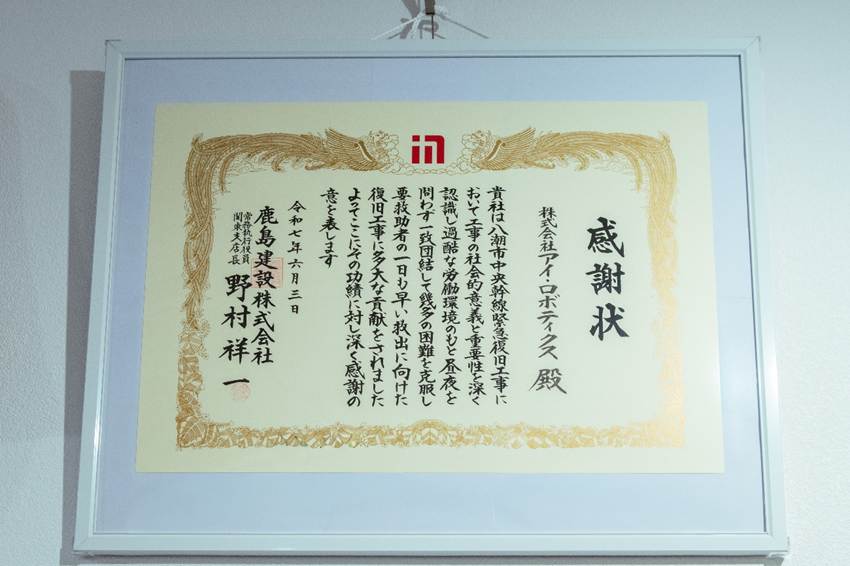
For example, the road collapse response in Yashio City, which earned the commendation hanging on that wall, was precisely one of those "last-minute rescue cases." In fact, several contractors had already been on-site before that, but they were facing challenges in getting things done smoothly.
Saito: Things not going well—it must have been quite a difficult environment.
Ando: While various factors contributed to the situation, the core issue was that "the necessary data couldn't be obtained." That's when we were approached. We thoroughly investigated the site and formulated a plan within about a week. We determined that "under these conditions, the required data could be acquired in just two flights," and proceeded accordingly. Each flight lasted only about three minutes. That alone yielded the target data.
This site featured a water storage pit (a facility for temporarily holding water), where large volumes of water were flowing, creating a challenge that prevented the target from being retrieved. To address this, we lowered the aircraft to a point approximately 8 meters below ground level and flew it to acquire 3D terrain data inside the pit. Using this data, we designed and constructed a bypass route for the drainage, contributing to the achievement of the objective. We observe the site, accurately grasp the objective, and plan and execute the optimal method.This approach is likely why we are trusted as a last-resort solution.
●Collaborative creation leading to verification and deployment. Case studies of collaboration with JR East
Saito: We also supported your activities through the Tokyo Consortium. How did things go with the introduction to JR East Startup, for example?
Ando: We are truly grateful for all the consideration you have shown us, allowing our company to experience such a challenging initiative. Following an introduction from the Tokyo Consortium, we applied to the JR East Startup Program, were successfully selected, and were able to proceed with various demonstrations.
The major challenges facing JR East are undoubtedly the shrinking workforce and aging infrastructure. Among these, non-destructive testing of concrete within tunnels is understood to be an urgent priority. Should an accident occur, it would cause significant operational disruption, passenger management issues, and compensation problems, delivering a major blow to the company's finances. This is precisely why daily inspections are indispensable. However, inspections are fundamentally conducted manually at night, allowing only a very limited area to be checked each day.While regulations require a five-year inspection cycle for the entire network, field personnel sought a method enabling efficient, accurate, and safe inspections.
Regarding that challenge, we decided to proceed with joint research and demonstration, exploring whether our mechanized construction solutions for elevated work could be applied. While originally developed for high-pressure cleaning and painting of building walls and roofs, this solution features modular components that can be flexibly reconfigured according to site conditions. Leveraging this "shared core technology," we undertook the development of a robot capable of performing non-destructive inspections inside tunnels.
Saito: Is that project still ongoing?
Ando: We are currently in the phase of considering whether to proceed to the next step. However, our company is steadily advancing preparations for the next phase. Depending on the current situation, we are also considering expanding to other projects and are simultaneously establishing the necessary framework. We hope to continue flexibly applying this technology to address social challenges.
●Sharing the "Now" of Industrial Robotics
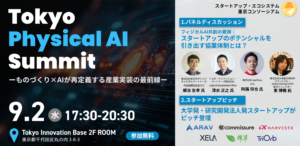
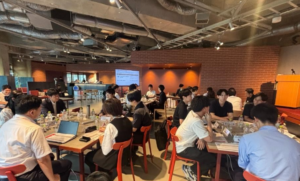
Saito: At the "Frontiers of Robotics Startups" event held at Tokyo Innovation Base (TIB), you were invited to speak as a startup at the forefront of the industry.
Ando: Thank you. The reason I participated in that event stemmed from a sense of urgency that we need to redefine the image of drones from an industrial perspective. I wanted to share the potential of using them not just for filming, but for industrial applications—to show what they can achieve.
The application scope of robotics expands dramatically not as a standalone technology, but when combined with other technologies. There was also a sense of urgency that unless we effectively promote this perspective—that "societal challenges can be solved depending on how tools are used"—industry recognition and implementation would likely remain stagnant.
So, we discussed with several startups that had previously been selected for Green Startup Support whether we could do something like a talk session, and that's how it came to fruition.
Saito: While attracting attendees is important for events, they also hold value as something that "remains" afterward, right? By making the activities visible through social media and such, it could potentially lead to inquiries, don't you think?
Ando: You're absolutely right. Sometimes the event itself triggers inquiries. Even if it's not the direct catalyst, when companies research us at some other point, having a history and information about such initiatives certainly builds trust. In fact, we've had cases where companies contacted us specifically because of that event we held at TIB. I feel it was a very meaningful opportunity in terms of expanding our recognition.
● Revolutionizing narrow-space inspection. One-stop service from imaging to analysis.
Saito: Could you tell me about the areas you're currently focusing on?
Ando: Our current focus is on developing inspection packages for confined spaces. Several packages are already complete. For instance, inspections utilizing 360-degree cameras and 4K-capable microdrones can now handle environments that were previously difficult for humans to access—such as narrow, dark, and dirty spaces.
What's even more distinctive is our ability to provide a seamless end-to-end solution—from shooting to 3D modeling and data analysis. We've been quick to adapt to the national initiatives of i-Construction and digital twin promotion, enabling us to deliver not just video and photo documentation, but near real-time 3D digital twin creation.
Typically, other companies shoot footage with drones, bring it back for processing, and spend about a week modeling it. However, if it's later discovered that "some areas were missed," they must return to the site for reshoots. We can visualize and verify data on-site, eliminating missed shots and significantly improving the efficiency of both filming and inspection.
Additionally, using a 360-degree camera allows coverage of all directions—up, down, left, right, front, and back—in a single flight. This eliminates the need for multiple flights required by conventional cameras, enabling significant reductions in both time and cost.
For example, in the case of railway facilities, the only time available for work is the brief 2 to 3 hours between the last train and the first train. According to estimates by a certain railway company, using conventional manual methods to inspect the ceiling space at a single station would require either closing the station for a week or setting up scaffolding every night, partially dismantling the ceiling, and then restoring it after work. This inefficient process caused significant inconvenience to customers and ultimately led to substantial revenue loss, highlighting a critical operational challenge.However, our system completes ceiling inspections for an entire station in just one day and two and a half hours. This speed and reliability have already earned high praise at numerous sites, driving its widespread adoption.
Another strength of ours is our one-stop capability for post-inspection data analysis and report generation.Our in-house team includes licensed architects, structural inspection specialists, and engineers holding national certifications in civil and electrical engineering. We handle everything from preliminary site surveys and actual inspections to 3D modeling, identifying areas of deterioration, and creating detailed reports from a professional perspective. This approach is highly valued by site managers, as it allows them to "focus on the tasks they should be doing."
● "Zero-to-One" Development Creates the Next Steady-State Operations
Saito: Please tell us about your future outlook.
Ando:Currently, our regular operations primarily involve periodic inspections of piping systems and confined spaces within water supply, railway, and plant facilities. As demand for these inspections grows, this service is becoming established as a core business. While our track record has primarily focused on infrastructure and plant sectors, we plan to expand into commercial facilities and urban development areas through collaboration with developers. Multiple projects are already underway to leverage our inspection and maintenance expertise in urban development and regional revitalization initiatives.
On the other hand, another major strength of our company lies in our ability to tackle "zero-to-one" technology development. We often serve as a last resort for clients seeking solutions to uncharted challenges, providing comprehensive support from fundamental R&D to full-scale social implementation. We then standardize and package these solutions, elevating them into our next regular business offerings. This dual-track approach—driving our business through both regular operations and zero-to-one development—is a unique characteristic of our company.
Additionally, we are currently developing new initiatives that will be announced soon. While we cannot share details at this time, we expect to be able to share them shortly, so please stay tuned.
Saito: Thank you. I look forward to your presentation.
Share the article