■Overview
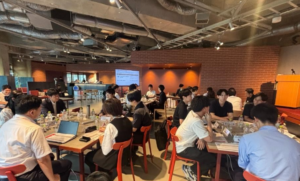
The "Collaboration Strategy Lab: A Workshop to Advance Co-creation Through Systems, Practical Operations, and Decision-Making Processes" was held primarily for operating companies, corporate venture capital (CVC) firms, and support organizations. The workshop aimed to share the institutional understanding and practical insights necessary to move startup co-creation into the "execution phase."The keynote address introduced the overall framework of the government’s startup policies, tax incentives for promoting open innovation, M&A support, and procurement promotion measures. The subsequent panel discussion covered a wide range of topics, including the objectives of expanding these systems, the reasons why companies are hesitant to act, and concrete examples of how operating companies are utilizing these resources, as well as innovative approaches to internal review processes.
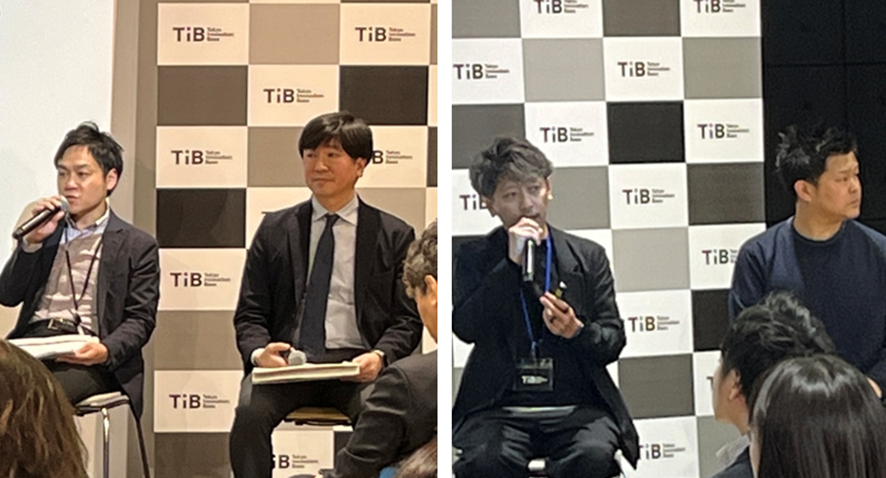
■Speakers
Ministry of Economy, Trade and Industry
・Yuta Sakaki (Assistant Director (General), Innovation and New Business Promotion Division, Innovation and Environment Bureau)
・Mr. Makoto Enomaru (Innovation and Environment Bureau, Innovation Creation and New Business Promotion Division)
KEIDANREN
・Shurei Kondo (Senior Manager, Industrial Technology Division)
KDDI Corporation
・Shunpei Tatebayashi (Deputy General Manager, Open Innovation Promotion Division, and General Manager, OI Business Development Department)
MOL PLUS Co., Ltd.
・Takuya Sakamoto (President and CEO)
Abeam Consulting Co., Ltd.
・Koyama (Tokyo Consortium Secretariat)
■ Main topics discussed on the day (talk themes)
Panel Discussion 1: Policy Discussion with Representatives from METI and Keidanren
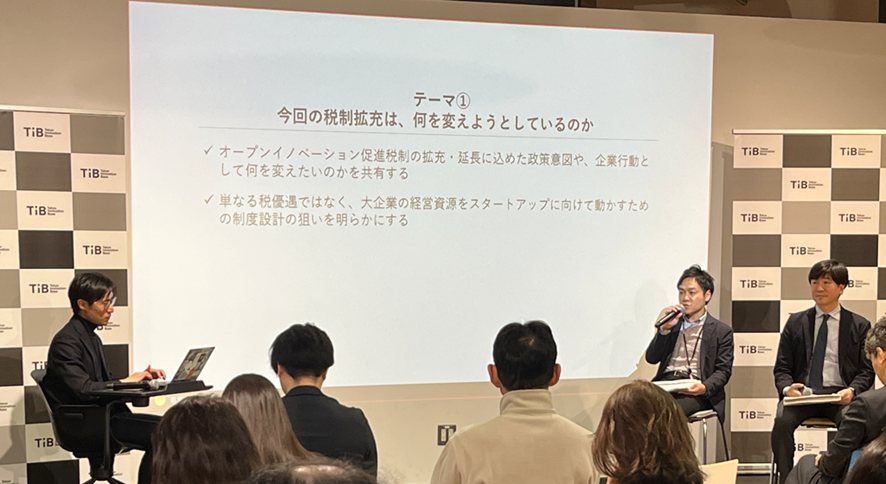
・What changes are intended with this expansion of the tax system?
・Why are companies unable to act?
・What is needed to make effective use of the system?
Panel Discussion 2: Case Studies on Large Corporations Collaborating with Startups Through Institutional Programs
・The catalyst and background for co-creation
・How did you utilize the system?
・Strategies for navigating internal review processes
・Results of collaborative efforts and ongoing initiatives
[Panel Discussion 1: Policy Discussion with Representatives from METI and Keidanren]
1) "What changes are these tax reforms intended to bring about?"
In this session, participants discussed how the expansion and extension of tax incentives for open innovation are viewed not merely as tax measures, but as a “catalyst” designed to drive behavioral change across the entire ecosystem—including large corporations, startups, and venture capital firms. In particular, there was a consensus that these measures serve as institutional support to broaden management decisions based on diverse growth strategies, including M&A, and to facilitate internal approval processes and investment decisions.
Furthermore, while industry representatives highlighted the practical benefits—such as the significant role tax incentives play in facilitating investment decisions and the expansion of eligibility to include minority investments—they also raised concerns regarding issues such as the inclusion of holding company structures.
2) "Why are companies unable to act?"
It was widely acknowledged that the reason why collaboration with startups, investment, and M&A are not progressing within companies is not merely a matter of assessing the risks of individual projects, but rather the extent to which co-creation with startups is positioned as a key strategic initiative within the company’s overall management strategy.
It was noted that if the importance of the initiative is not fully recognized at the management level, it becomes difficult to foster internal understanding and build consensus. Furthermore, it was acknowledged that greater awareness of the system is needed, and that even when people are aware of it, the complexity of procedures and the operational burden can act as barriers. In particular, it was pointed out that startups face difficulties in effectively utilizing the system given their limited organizational resources.
3) "What is needed to make effective use of the system?"
It was emphasized that management commitment is essential for translating these systems into actual co-creation, procurement, investment, and M&A activities. It was noted that only when management takes the initiative can open innovation and M&A be integrated into corporate strategy; furthermore, the integrated use of various systems enables the development of internal frameworks and the design of concrete operational processes.
Furthermore, when implementing the system, the importance of involving administrative departments—such as accounting, finance, legal, and corporate planning—at an early stage, in addition to explaining the specific benefits to senior decision-makers, including the CFO, was highlighted as a key consideration. It was also noted that identifying utilization models suited to the company’s specific needs by referencing case studies from other companies and insights from support organizations is an effective approach for promoting the system’s adoption.
[Panel Discussion 2: Case Studies on Large Corporations Collaborating with Startups Through Institutional Programs]
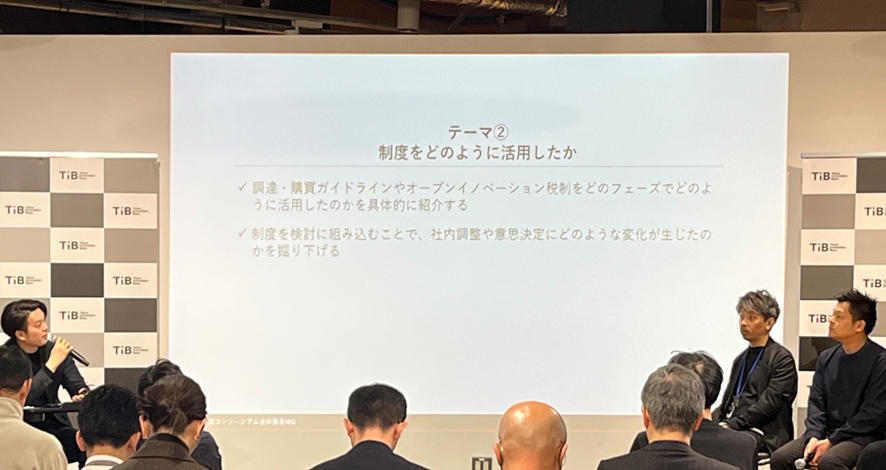
4) “How did you utilize the system? / How did you navigate the internal review process?”
As an example from a business company, it was noted that the system functions as an “accelerator” for decision-making.
KDDI presented its approach to open innovation, which it views as a key driver of its growth, combining multiple strategies such as acceleration programs, business matching, corporate venture capital (CVC), overseas VC investments, mergers and acquisitions (M&A), and partnerships with academia.
MOL PLUS shared how it had worked to build consensus within the company by presenting concrete examples and engaging in dialogue with external stakeholders, with the aim of fostering an understanding that collaboration with startups is a viable option.
Furthermore, specific measures to advance internal deliberations were highlighted, such as KDDI’s long-standing efforts to instill the sense of urgency characteristic of startup projects within its back-office departments, thereby enabling operations capable of responding quickly, and MOL PLUS’s approach of ensuring the independence of its corporate venture capital (CVC) decision-making by establishing decision-making functions that are to some extent separate from the parent company.
5) "Achievements and Ongoing Initiatives"
It was noted that, when assessing results, value lies not only in the success or failure of individual IPO or M&A deals, but also in the fact that we have expanded our “toolkit” and “options” for engaging with startups.
KDDI cited as an achievement the fact that it can now engage in multiple forms of involvement, including small-scale investments, acquiring a certain percentage of equity, joining the group, and providing IPO support.
MOL PLUS also pointed out that simply creating a situation where one has options for the future—as opposed to doing nothing—is in itself a significant achievement.
The Ministry of Economy, Trade and Industry has established a range of support programs not only for equity-related transactions but also for various forms of open innovation, such as secondments, procurement, and joint research, and has expressed its intention to continue promoting open innovation in the future.
■Post-Event Survey
Following this workshop, we asked participants to complete a survey. The purpose of this survey was to gauge satisfaction with each session of the event and to gather participants’ opinions regarding the promotion of open innovation (OI), including their perceptions of challenges, suggestions for institutional improvements, and future initiatives.The questionnaire consisted of four sections: satisfaction and impressions regarding the keynote speech and panel discussion sessions; challenges and background related to promoting OI; regulations and systems participants would like to see relaxed; and outlook and future initiatives following the event.
Respondents represented a diverse range of organizations, including operating companies, venture capital firms, financial institutions, and universities and research institutions, and overall satisfaction with the keynote speech and panel discussions was high. Feedback indicated that information on policies and tax systems was systematically organized, enabling participants to deepen their understanding by relating it to the practical aspects of co-creation.Furthermore, the event helped clarify key issues that need to be addressed, such as engaging internal stakeholders and establishing implementation frameworks to promote OI, identifying potential collaboration partners, commercializing projects following proof-of-concept (PoC) phases, and managing contractual and intellectual property matters. It also provided insights into potential directions for improving the institutional framework. In summary, this event served as a valuable opportunity for participants to disseminate the insights gained both internally and externally and to use them as a foundation for planning future initiatives.
■Summary
This workshop made it clear that, when it comes to fostering co-creation with startups, simply “knowing” about the system is not enough; it can only be effectively utilized when it is integrated with the company’s strategic direction, the commitment of senior management, internal structures—including administrative departments—and the practical processes carried out on the ground.
It was also noted that tax systems and guidance should not be viewed merely as subjects for institutional explanation, but rather as practical support measures designed to help companies move forward with decision-making while considering multiple options, such as co-creation, investment, M&A, and procurement.
Ultimately, the session highlighted that for a business company, the most important outcome is not merely the short-term results of individual projects, but rather avoiding “opportunity costs resulting from inaction” and establishing a foundation that enables the company to move forward into the future.
Share the article