1. Event Overview
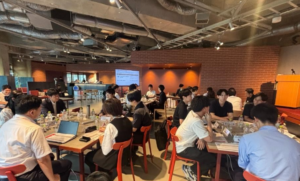
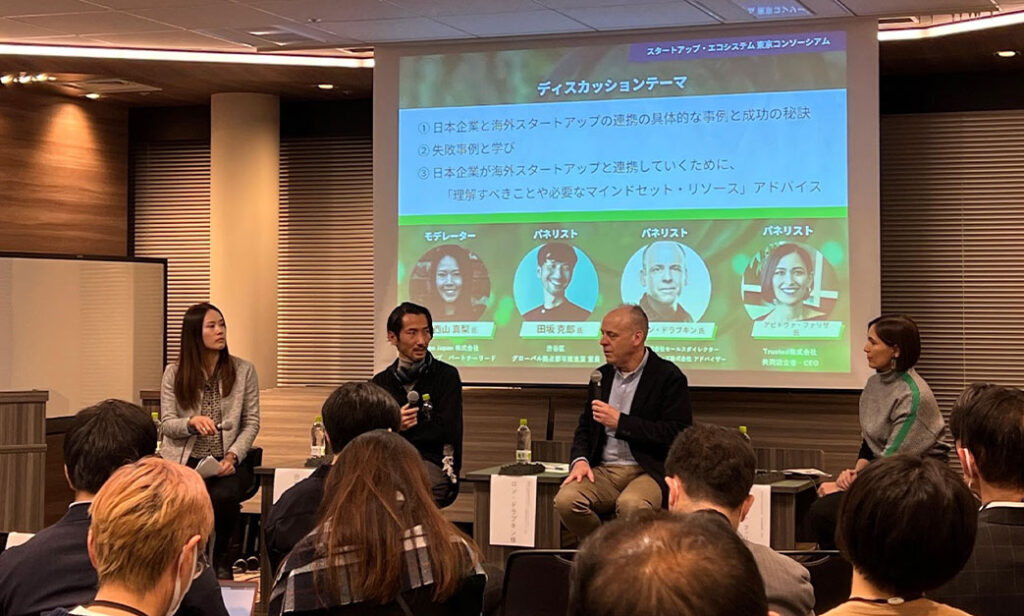
The Tokyo Consortium held an event titled "Collaboration Between Overseas Startups and Japanese Companies" at Shibuya Solasta Conference on Friday, February 17, 2023.The event featured a panel discussion with four speakers: Mr. Katsuro Tasaka from Shibuya City, Ms. Mari Nishiyama from Stripe Japan, Inc., Mr. Ron Drabkin from Miles Japan, Inc., and Ms. Abidwa Fariza from Trusted, Inc.
2. Event Implementation Overview
(1) Mr. Tasaka's Lecture: "Barriers to Overseas Startups Entering the Japanese Market"
Shibuya Ward supports startups through three key themes: ecosystem building, proof-of-concept implementation, and internationalization. For ecosystem building, we establish specialized committees addressing specific challenges faced by startups, engaging large corporations to support their initiatives. Regarding proof-of-concept implementation, we have established a system primarily targeting B2C startups, enabling them to recruit Shibuya residents registered as monitors to participate in their proof-of-concept projects.For internationalization, to attract diverse overseas startups, we are specifically working on issuing various types of visas for startups, attracting international events, and operating media that introduces Japanese startup events and companies. Furthermore, we launched SHIBUYA STARTUP SUPPORT to provide support during the "growth" phase after attracting startups, collaborating with large corporations.
Among the challenges that have come to light are language barriers for investors, local governments, and large corporations; visa issuance for recruiting diverse talent; and providing sufficient support for daily living.
(2) Panel Discussion: "How Japanese Companies Can Collaborate with Overseas Startups"
Mr. Nishiyama moderated a panel discussion on collaboration between Japanese companies and overseas startups. Participants included Ms. Fariza, who is involved in projects promoting such partnerships; Mr. Drabkin, representing overseas startups and investors who have successfully entered the Japanese market; and Mr. Tasaka, who supports overseas startups entering Japan.
Theme 1: Current Status and Challenges in Collaboration Between Japanese Companies and Overseas Startups
Regarding the current state of Japanese companies collaborating with overseas startups, they largely fall into two categories: those that have been strengthening their partnerships for some time, and those that want to collaborate but don't know where to start.For the former, while investments in startups themselves are often successful, they frequently fail to fully engage the entire company. Consequently, they often end without fostering synergies from overseas startup collaborations. For the latter, companies often have sufficient research on overseas startups but struggle to take concrete action.
The reason why collaborations with overseas startups have not been successful lies in the fact that the entire company, particularly the management, does not fully understand the reasons for collaboration or its benefits. Due to the siloed structure characteristic of large corporations, a disconnect arises between the direction of the open innovation promotion department and the management control department. Consequently, the management control layer requires significant time to understand the benefits of collaborating with startups and to make decisions.
While it's difficult to immediately change the organizational structure of large Japanese corporations, I believe they can effectively collaborate with overseas startups by adopting an approach seen in European corporations: creating a completely separate innovation promotion team as a distinct company. This allows projects to operate freely, and if successful, they can be integrated into the parent company.
Theme 2: What Japanese Companies Need to Understand and the Mindset Required for Collaboration with Overseas Startups
To foster collaboration and synergy with overseas startups, Japanese companies must adopt a company-wide approach, extending beyond dedicated innovation teams. While management often tends to be cautious about partnering with overseas startups, it is crucial for innovation teams to repeatedly provide logical explanations to management about the reasons for collaborating with startups, thereby securing company-wide consensus.I strongly encourage you to pursue these collaborations by following the advanced examples of major overseas corporations in their startup partnerships and by directly reaching out to those who have successfully fostered such collaborations and synergies.
Furthermore, the lack of purpose among Japanese individuals in Silicon Valley has been identified as a challenge. Specifically, opinions include that it is unclear what Japanese individuals aim to achieve by coming to Silicon Valley, and that they only seek to obtain information without contributing anything in return. To address this challenge, it is necessary to cultivate a sense of purpose regarding overseas startup collaboration among Japanese companies. This can be achieved through initiatives such as workshops designed to deepen understanding of the reasons for collaborating with foreign startups.
(3) QA Session
Participants at this event primarily asked the following three questions, to which our four speakers provided answers.
Question 1: How can Japanese companies find the best overseas startups?
First, it is crucial to define the purpose of collaborating with overseas startups and then search for startups that meet the criteria.However, it is often difficult to get a response from startups when attempting to contact them. Therefore, it is necessary to solidify your thoughts on the specific project concept, the required track record and conditions for the startup company that matches it, and the potential synergies, before directly pitching to startups. Additionally, you can consider leveraging networks with investors, venture capital firms, or accelerators that have connections to overseas startups to approach them indirectly.
Question 2: The strengths of Japanese companies for overseas startups
Among the strengths Japanese companies offer when collaborating with overseas startups is the national character of the Japanese people, such as their tendency to consider matters with a long-term perspective. Furthermore, Japanese companies themselves can benefit from collaborating with overseas startups possessing fresh perspectives, enabling them to swiftly and efficiently create new innovations.
Question 3: How to communicate the benefits of collaborating with overseas startups to management, despite barriers such as language differences.
First, it is crucial to place bilingual professionals fluent in both English and Japanese primarily within departments focused on collaborating with overseas startups, such as innovation promotion or research divisions, to overcome language barriers. Furthermore, to shift the mindset of senior management, it is essential to identify approaches tailored to each company's characteristics and present logical explanations to executives. In this context, facilitating participation in ecosystem events and creating opportunities to gather authentic feedback from diverse stakeholder perspectives can also be highly beneficial.
Event Overview
| Date and Time | Friday, February 17, 6:00 PM to 7:30 PM |
|---|---|
| Speaker | Shibuya City Global Hub City Promotion Office Director Mr. Katsuro Tasaka Stripe Japan K.K. Startup Partner Lead Ms. Mari Nishiyama Miles Japan K.K. Sales Director, Archetype Ventures K.K. Advisor Mr. Ron Drabkin Trusted K.K. Co-founder & CEO Ms. Abidwa Fariza |
Share the article