1. Overview
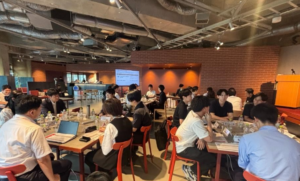
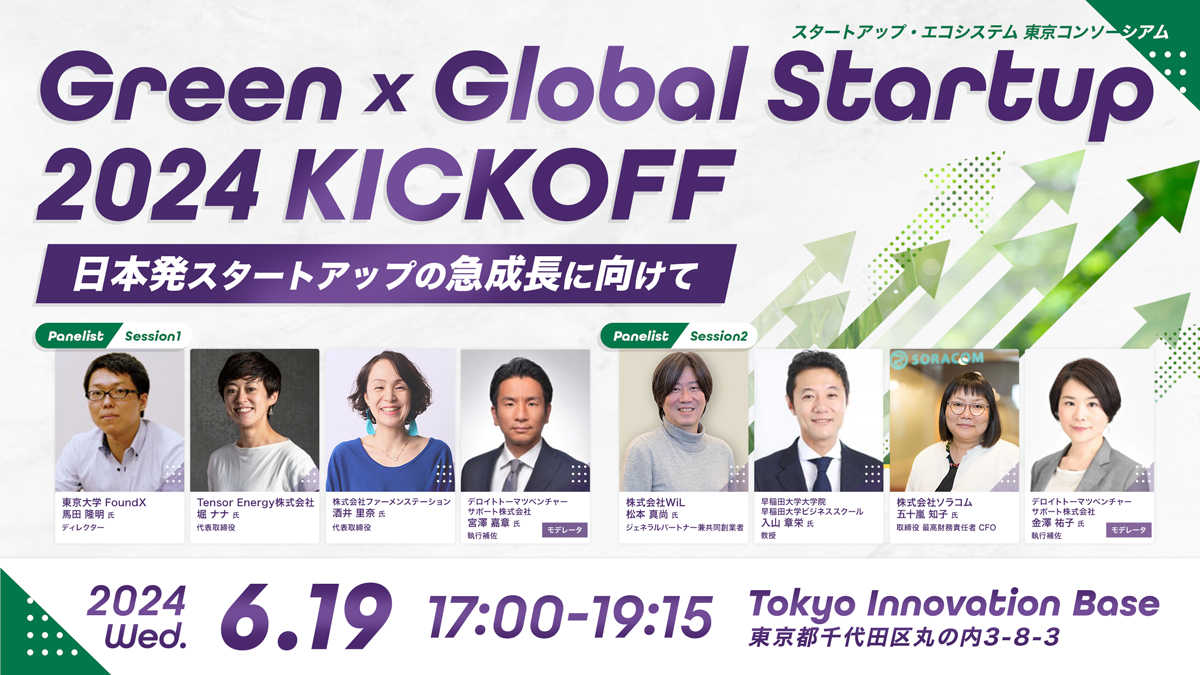
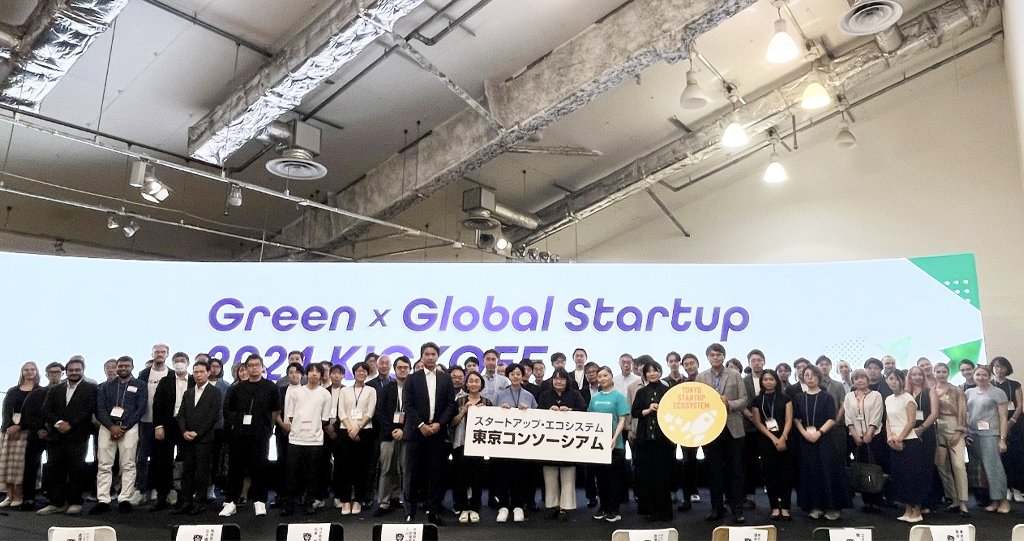
The Startup Ecosystem Tokyo Consortium held "Green×Global Startup 2024 KICKOFF" at Tokyo Innovation Base on June 19, 2024.The event featured two sessions: "The Key to Rapid Growth for Japan's First Climate Tech Startup" and "Exploring the Backstory of Japan's First Swing-by IPO." Each session was followed by a Q&A, and a networking session took place after the event concluded.
2. Event Implementation Overview
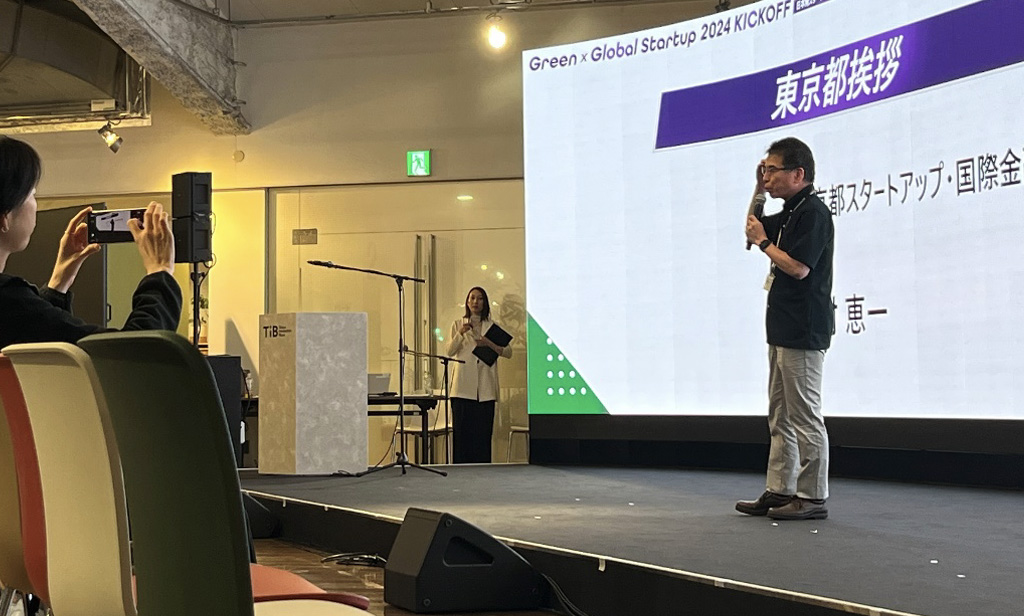
① Greetings from Keiichi Yoshimura, Director of the International Financial City Strategy Office, Tokyo Metropolitan Government
At the opening, Keiichi Yoshimura, Director of the Tokyo Startup and International Financial City Strategy Office, delivered opening remarks to the participants gathered at the venue. He stated that, spurred by the Startup Strategy formulated last year, significant progress had been made over the past year to substantially expand the ecosystem.Specifically, he highlighted that since the opening of Tokyo Innovation Base, over 130 events have been held, with more than 14,000 people utilizing the facility as of today, June 19. He also mentioned that the SusHi Tech Tokyo global conference, held at Tokyo Big Sight on May 15 and 16, 2024, attracted over 40,000 participants. More than 430 startups from Japan and abroad exhibited, and over 3,000 business meetings were conducted.
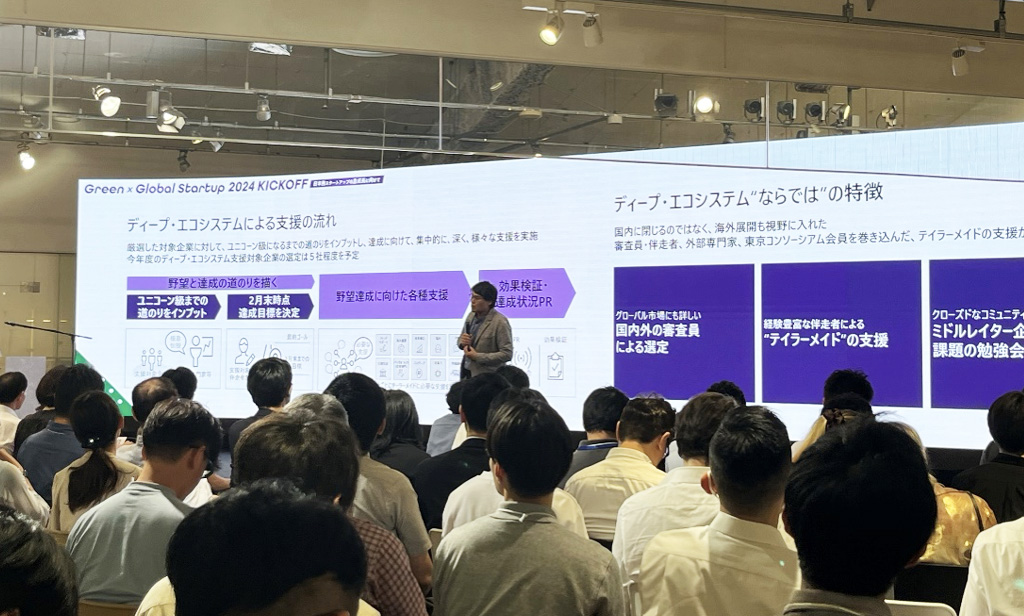
② Yosuke Morimoto from the Tokyo Consortium Secretariat provided an overview of the Tokyo Consortium.
3. Session ①: The Key to the Rapid Growth of Japan's First Climate Tech Startup
【Speakers】
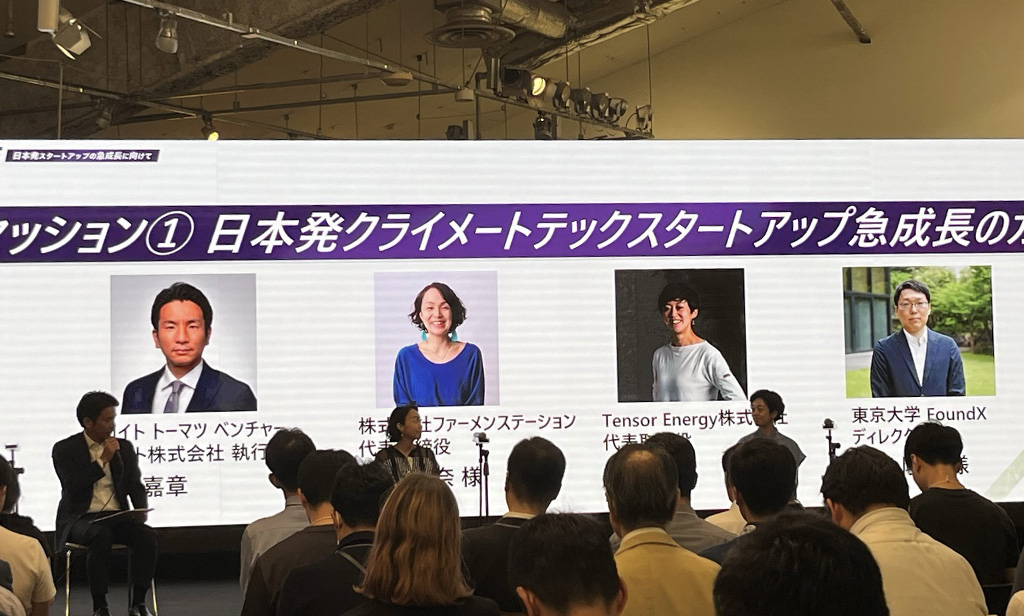
Takaaki Bada, Director, FoundX, The University of Tokyo
Nana Hori, Representative Director, Tensor Energy Inc.
Rina Sakai, Representative Director, FermenStation Inc.
【Moderator】
Deloitte Tohmatsu Venture Support Co., Ltd. Executive Assistant Yoshiaki Miyazawa
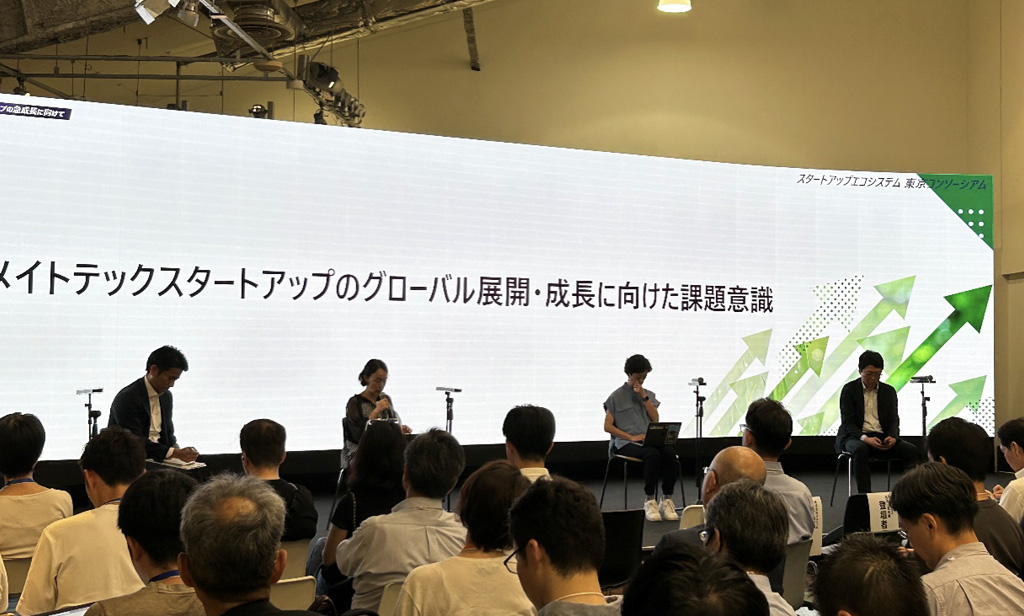
A panel discussion was held with Mr. Takaaki Bada, Director of FoundX at the University of Tokyo; Ms. Nana Hori, Representative Director of Tensor Energy Inc.; and Ms. Rina Sakai, Representative Director of FermenStation Inc., alongside moderator Miyazawa. The session began with introductions from the three panelists, followed by their discussion on three key topics. Below is an excerpt and summary of their discussion.
① Challenges in the Global Expansion and Growth of Climate Tech Startups
Miyazawa: What challenges do you see for climate startups in global expansion and growth?
Mr. Mada (hereinafter referred to without honorifics): First, there are few startups engaged in climate tech. While this can be an advantage in terms of less competition, it also makes it difficult to accumulate know-how in this field, and successful startups are hard to come by.Since green and climate issues are global challenges, the environment is ripe for global startups to emerge, but the problem is that demand in the domestic mother market is still insufficient. This raises the question of what the point of starting a business in Japan actually is, making it difficult for global startups to emerge from Japan. I believe that the key to global expansion and growth lies in how to create domestic demand.
Mr. Sakai (hereafter referred to without honorifics): I completely agree with Mr. Bada's earlier point about the scarcity of startups tackling climate tech. With so few domestically, there's no competition driving mutual improvement.I once had the opportunity to participate in an overseas program supporting mid-to-late stage global climate tech startups. What struck me then was how many competitors exist in this field in Europe and the US. Without awareness of this, Japanese startups in this space will lose out. Furthermore, while massive capital flows into this sector overseas, funding opportunities and demand are scarce domestically, forcing many to look abroad.Furthermore, with few reference cases and limited domestic networks, information is scarce, leaving operations largely a trial-and-error process.
Mr. Hori (hereafter referred to without honorifics): What frustrates me as our company expands overseas is that Europe has already taken the lead in power systems, making it difficult for us to target that market now. In climate tech as well, I feel Japan needs to engage in a European-style approach, getting significantly involved right from the rule-making stage.
Umaeda: Also, recently, a startup I'm supporting visited Australia to observe technological trends and reportedly realized that Japanese technology is actually overwhelmingly stronger. Japanese startups aren't venturing overseas, so they're unaware of Japan's strengths. Another challenge is that precisely because they don't go abroad, they fail to recognize the fact that Japan possesses strong manufacturing suppliers.
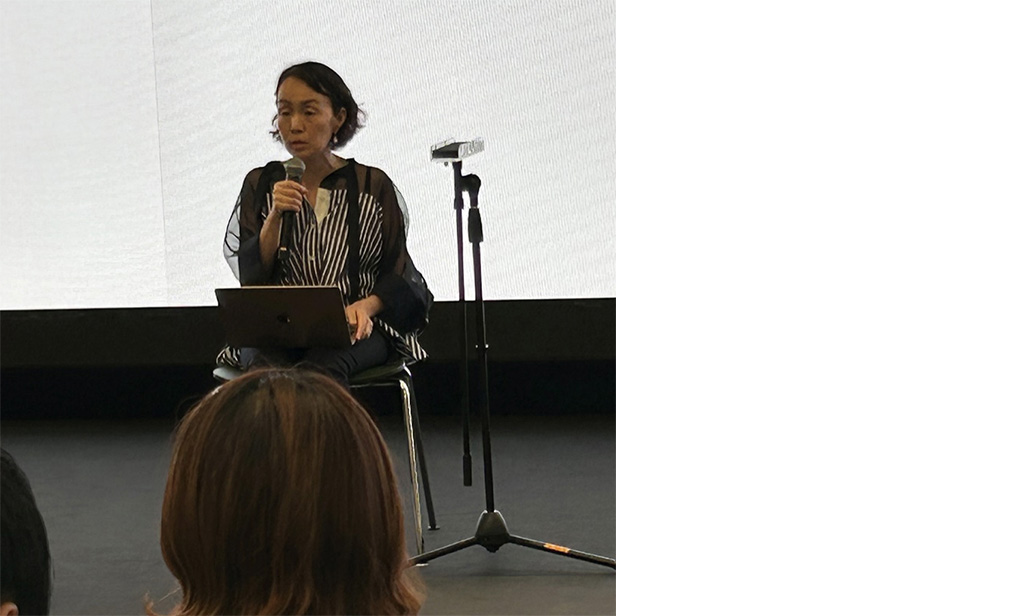
Support Measures Desired for Climate Startups
Sakai: First, we strongly hope SusHi Tech Tokyo will continue. SusHi Tech Tokyo is large-scale and has engaged not only with domestic but also international ecosystems. Furthermore, SusHi Tech Tokyo has positioned itself as a global hub for startups, and this message will lose meaning if it isn't sustained going forward. I hope that someday its reputation will grow, making it an event that many startups, both domestic and international, aspire to participate in.
Furthermore, while the Tokyo Metropolitan Government and national government offer various support programs for overseas expansion, these primarily target SaaS and tech companies. On the other hand, I feel there are still few programs specifically for climate tech. I hope we can see the creation of programs that better match the actual needs of this sector.
Hori: First, from the perspective of rule-making and system development, I think it would be great if startups could collaborate with policymakers and large corporations. Another point is that while Japanese startups have traditionally focused on peripheral areas untouched by large corporations, looking at overseas examples, I get the impression that startups tackling core domains are achieving significant growth. In response to this, support that goes beyond just capital—support that helps build a track record—would be especially helpful, particularly in the early stages. Additionally, assistance in building networks with local partners is something I feel is extremely valuable support.
Miyazawa: Was there any support from the Tokyo Consortium that proved useful?
Hori: We received a wide range of support from Green Startup Support. I remember it being especially helpful during the founding period, when we had to handle all kinds of tasks simultaneously. Approaching large corporations was also a significant challenge, but I believe we received tremendous support in that area as well and were able to secure many leads.
Umaeda: Unlike the two of you, I'm involved in this field purely as a supporter. What I've noticed is that the approach to support is changing. Unlike when supporting IT and other sectors, climate tech requires significant costs for hypothesis validation in the early stages, so we need to focus our efforts to some extent. Supporters must therefore rethink how we provide assistance to nurture startups into unicorns. There are two specific support methods. The first is market-driven support.The interesting aspect of climate tech is that it doesn't necessarily require the latest technology. Even older technologies can be applied to new markets, so support must be tailored to the current market landscape. The second is support focused on creating demand. Innovative products won't sell if buyers lack the mindset to drive innovation. Therefore, creating new demand is what is likely required of large corporations and governments. I believe support focused on how to foster innovative procurement within Japan will generate this demand.
Miyazawa: Both of you are developing businesses centered on technology. What are your thoughts on the market-driven support approach Mr. Bada mentioned?
Hori: We greatly appreciate the support in building a track record. As the market itself grows larger, it should have positive effects not only for startups but for Japan as a whole.
Ueda: I believe the rule-making Mr. Hori mentioned earlier is extremely important. A certain degree of regulation actually creates demand. This fosters the growth of industries, so the government should support that aspect.
Hori: I believe it's crucial to have a system where solving social issues generates economic benefits. That's why policies that provide incentives are important.
The Role of Climate Startups in Achieving Net Zero
Sakai: Startups and businesses in the climate tech sector are essential. Japan must build a circular society within its limited resources, presenting significant business opportunities. I look forward to working with like-minded individuals to realize this vision across borders.
Hori: Running a startup is like running with a ticking time bomb. Conversely, we are the kind of people who can take risks. If you can effectively leverage us and take on a little risk yourselves, I believe this field will expand even further.
Umaeda: I believe startups, not just in the climate sector, have a societal role to play in presenting ideals and hope. Furthermore, maintaining a positive outlook is crucial. I think one of our roles is to demonstrate a positive stance—that we can not only confront climate change and disasters but also solve them, and that the means to do so exist. I believe this kind of attitude from startups can also motivate large corporations to take action.Moreover, I see the climate sector as the culmination of the startup ecosystem cultivated over the past decade. It must be global in scope, and it's an area where governments and large corporations also have significant roles to play. Even within academia, it's necessary to gather technologies from various universities, not just one, to build a single venture. Therefore, I believe the climate sector holds a role of great expectation for the startup ecosystem. I look forward to continuing to collaborate with diverse partners in this effort.
Q&A Session
Q: "What kind of funding strategy are you pursuing amid a sluggish domestic market?"
A. Sakai: "We just wrapped up a round relatively recently. We plan to maintain relationships with domestic investors who are looking to invest in impact areas, climate change initiatives, and global expansion."
A. Hori: "We sometimes hear from Silicon Valley that we should leave Japan, but we intend to stick it out domestically a little longer."
4. Session ②: Exploring the Inside Story of Japan's First Swing-by IPO
【Speakers】
WiL Inc. General Partner and Co-Founder Mr. Masahiro Matsumoto
Waseda University Graduate School Waseda University Business School Professor Mr. Akiyoshi Iriyama
Soracom Inc. Director and Chief Financial Officer (CFO) Ms. Tomoko Igarashi
【Moderator】
Deloitte Tohmatsu Venture Support Co., Ltd. Executive Assistant Yuko Kanazawa
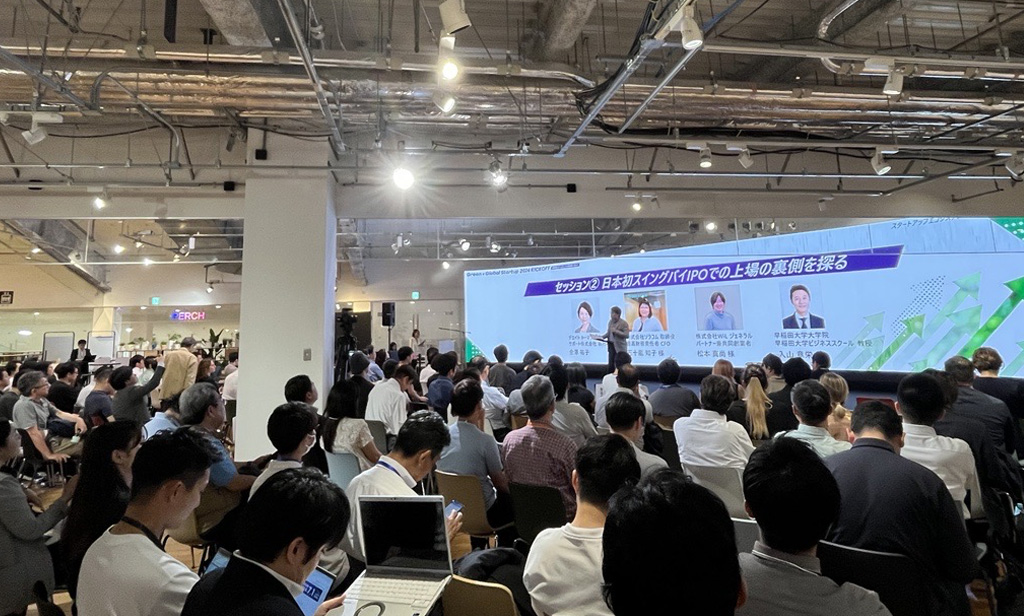
A discussion was held with special guests Mr. Masahiro Matsumoto, General Partner and Co-Founder of WiL Inc.; Professor Akiyoshi Iriyama of Waseda University Graduate School and Waseda Business School; and Ms. Tomoko Igarashi, Director and Chief Financial Officer (CFO) of Soracom Inc., moderated by Kanazawa. The session began with self-introductions from the three guests, followed by the discussion. Below is an excerpt and summary.
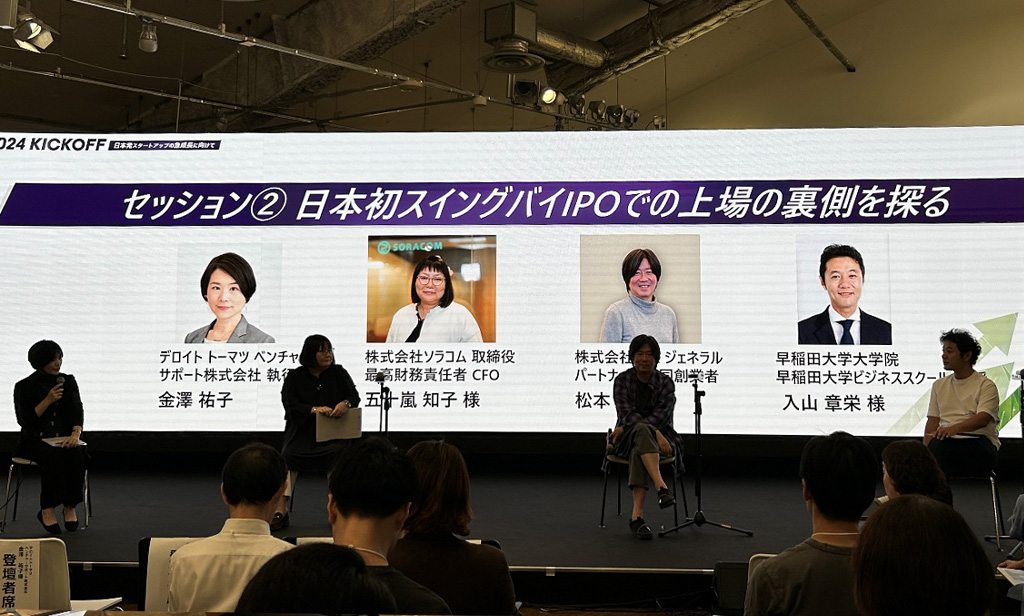
Kanazawa: First, let me explain what a swing-by maneuver is. In space terminology, a swing-by refers to a spacecraft using a planet's gravity to accelerate. Here, the planet represents a large corporation. We use the swing-by analogy to describe a startup accepting a merger or acquisition by a major company once, then leveraging that company's assets.The primary benefits include fully leveraging the large corporation's funding, resources, and credibility. The drawbacks are that once acquired, independence is lost, governance becomes more complex, and there is a risk of cultural conflicts arising.
① Soracom's Journey of Collaboration with KDDI
Mr. Igarashi (hereafter referred to without honorifics): Soracom was founded in November 2014. We have offices in Tokyo, the United States, and London, with a total of 150 employees. Given our original global ambitions, one-third of our members are based overseas. Our business is a B2B service providing a global IoT platform service that supports everyone's digital transformation (DX).While we were a unicorn company that joined the KDDI Group, we intended to grow significantly under the umbrella of a major corporation. After joining the large group, we considered an IPO as an option for a new challenge to leap further globally, leading us to announce the concept of a swing-by IPO. As a track record, when Soracom joined KDDI, we had 80,000 IoT lines. By 2020, this had grown to 2 million lines, and we have now surpassed 6 million lines.
The swing-by IPO strategy is structured like a three-stage rocket. The first stage involved changing our capital policy, the second stage involved the participation of six shareholders. Ultimately, we achieved our listing in March 2024.
Kanazawa: I understand the swing-by IPO is a three-stage rocket concept. How did this concept come about?
Igarashi: We considered that pursuing a capital strategy separate from KDDI might give the impression of a strained relationship with them. That wasn't the case; we needed to create a positive concept aimed at achieving further growth. Additionally, all members share a passion for space, and the name reflects our desire to leverage the assets of a major corporation to reach the next level.
Kanazawa: What were the challenges you faced while pursuing the swing-by IPO? And how did you overcome them?
Igarashi: While acknowledging the necessity to change processes even if the unique outcomes of large corporations remain unchanged, I believe we've overcome this by carefully taking each step.
Mr. Matsumoto (hereafter referred to without honorifics): I believe the reason we were able to achieve a swing-by IPO was that KDDI and Soracom agreed to expand their business globally.
Kanazawa: Swing-by IPOs are said to be a win-win scheme for large corporations and startups. What do you think are the conditions that make this a viable option?
Mr. Iriyama (hereafter referred to without honorifics): The most critical condition is the characteristics of the president of a large corporation. It is essential that they be steadfast, strategic, and capable of long-term leadership. Companies where the president changes every two or three years will not succeed with a swing-by IPO. Secondly, the condition for the startup side is that it must be global. Business expands by going overseas. Startups operating small-scale businesses domestically find it difficult to execute a swing-by IPO.
The third condition is being serious. Soracom is a rare company where nearly everyone is science-oriented and they made it to an IPO. I believe it's crucial to be extremely serious, sincere, and have an unwavering core.
Q&A Session
Q: As a VC fund that invested from the seed stage, did it ultimately yield good results?
A. Matsumoto: Considering the total financial return, it can be said to have yielded very good results.
Q: I believe it was precisely because people with guts and high aspirations gathered together that you achieved Japan's first swing-by IPO listing. How do such encounters come about?
A. Matsumoto: At Soracom, the members' aspirations have never wavered since founding. I think such people naturally gravitate toward such an organization.
A. Iriyama: I don't think you need to overthink "encounters."If you possess that kind of purpose or appeal, you will naturally engage with people of high purpose. Soracom's founder was a fellow study abroad student, and he's an exceptional person. Naturally, good people gravitate towards such individuals.
A. Igarashi: I believe it's about positioning yourself in a way that invites support. While this swing-by IPO is an important milestone for us, we don't see it as the end; rather, it's a step towards the next phase. Increasing the number of supporters who back us is crucial.
Share the article