The most feasible areas in the world of science fiction
Ozawa: First, could you tell us about the circumstances that led Mr. Hanyu to establish IntegriCulture?
Hanyu: Originally, I was drawn to the world of science fiction and its sense of romance, which led me to pursue a career in science. During my doctoral studies at university, I researched nanotechnology, and after graduating, I worked in the environmental energy field. However, my desire to embody the world of science fiction grew stronger. As various ideas came to mind, I arrived at "cultured meat" as a field where I could realistically take on the challenge.
In reality, when I tried to tackle this field, I lacked both funding and knowledge, and gathering members was difficult.Moreover, I felt that such a society-changing innovation emerging from existing structures wouldn't be interesting. I decided to spread it as an open-source project. Initially, I started the open-source project in a sort of "semi-business" format. Through this process, various people gathered, forming the "Shojinmeat Project," essentially a fan circle. We're still active today, publishing fan magazines and technical books.
As many people gathered and discussions about cell-based agriculture progressed, we realized: "We don't see the appeal of one large corporation monopolizing this technology when it enters society," and "There's a risk it could provoke backlash, similar to genetically modified foods." Therefore, what's needed is an ecosystem.We envisioned a collaborative core for societal implementation, involving profit-driven entities to disseminate the technology, non-profits to establish rules alongside government and academia, and groups like artist collectives and citizen science initiatives—who can pursue truly cutting-edge work unencumbered by adult constraints—alongside doujin circles. This ecosystem would be formed by organizations like the Japan Cellular Agriculture Association, Integrigulture Inc., and Shojinmeat.
This ecosystem concept aligns with our company's vision. At Integrigaculture, we aim for "cell agriculture accessible to everyone." We want to build the cell agriculture infrastructure and realize a society where diverse people can use this infrastructure to create new things.
Ozawa: Thank you. Among the various research themes, why did you focus on cultured meat?
Hanyu: There are truly many different themes, aren't there? Mars colonies, mass drivers (※), and so on—there are countless things I'd like to pursue. However, when I realistically considered "what should I tackle now?", I felt cultured meat held potential. I believed cultured meat would become mainstream by the mid-21st century, and the fact that it's not physically impossible was also a major reason.
※Technology appearing in science fiction works that transports cargo and spacecraft into space
Ozawa: In science fiction, are there any works featuring cultured meat that left a lasting impression on you?
Hanyu: There are simply too many to recall specific works, but they often appear as standard elements within the sci-fi world. I enjoy the "world of sci-fi" itself, rather than the works or literature per se. This perspective might be a bit different from that of traditional sci-fi fans.
Ozawa: I see. To get back to the topic, could you explain what specific roles IntegriCulture, the Japan Cellular Agriculture Association, and Shojinmeat each play?
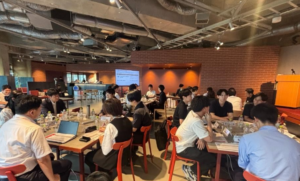
Hanyu: For example, the Japan Cellular Agriculture Association held an academic conference called the "Cellular Agriculture Conference" on August 29th, where many researchers gathered to present their work. Representatives from the Ministry of Education, Culture, Sports, Science and Technology (MEXT), other government ministries, and companies also participated, making it a huge success.At the conference, the focus was on academic discussions. I think it was great that very pure discussions took place about things like how far the technology has advanced and methodological approaches.
On the other hand, "Shojinmeat" is a fan circle where people gather freely to engage in activities without any membership or fixed definition. We freely do things like making cultured meat at home, creating artworks, and supporting creators. We've even posted videos on Niconico titled "We Made and Tried Cultured Meat."
Ozawa: Niconico Video? That's interesting.
Hanyu: Recently, "bioartists" have been gaining attention for creating works using cell cultures. While conventional art expression primarily involves techniques like painting, carving, or sculpting, bioart creates works through the process of "cultivating." In that sense, bonsai could be considered a precursor to bioart.We have supported several projects that shape form through this process of "cultivating." Recently, an artist exhibited a work titled "Dragon's Flesh" under the name "LOM BABY" at the The National Art Center, Tokyo.
Ozawa: It's truly fascinating. I believe very few people in Japan are engaged in this kind of work, and I find it incredibly unique and cutting-edge. I think this spirit is reflected in the very essence of IntegriCulture, and it's precisely because of this vision that IntegriCulture exists today.
The underlying spirit of "expanding culture"
Ozawa: Could you also tell me about the role of integrated farming?
Hanyu: Integral Culture aims to build trusted social infrastructure. In other words, we strive to realize our vision of "cell agriculture accessible to everyone" and provide infrastructure that can be used with peace of mind.
Ozawa: What kind of sentiment is embodied in that?
Hanyu: What Shojinmeat, cell agriculture, and IntegriCulture share is the spirit of "cultivating culture." As a means to cultivate culture, we aim for "cell agriculture accessible to everyone." What we create there is "living matter."The products might be food, or cosmetics, or even cellular components. I believe this also encompasses the bio-art mentioned earlier and the "muscle-powered robots" being researched by Professor Shoji Takeuchi at the University of Tokyo (*). By creating such "living matter," we hope to foster the birth of new cultures.
Professor Masaharu Takeuchi is a professor at the Graduate School of Engineering, The University of Tokyo. He is a researcher specializing in bioengineering, which integrates biology and engineering to develop new technologies; microfluidic devices, which utilize micro-scale fluid control technology to develop biosensors and Lab-on-a-Chip devices; and cell engineering, which develops new technologies for manipulating and analyzing cells.
Ozawa: So that approach to creating fresh products is reflected in IntegraCulture's current business as well. Could you tell us specifically what kinds of businesses are progressing, such as food and cosmetics?
Hanyu: In terms of perishable goods production, I believe there are things we can do now and things we can achieve in the future, as well as things that can be done cheaply and things that are costly. Among these, the first area we tackled as something currently profitable and feasible was the cosmetics field.
Ozawa: So cosmetics came first, huh?
Hanyu: Yes, "Cell Ag Cosmetics" is a type of fresh product. It's a field that handles ingredients derived from living organisms, such as human stem cell cultures and collagen. There are opinions that killing animals to use animal-derived ingredients is undesirable, so generally, byproducts from food production are utilized. However, there are challenges with supply stability. In that regard, producing cosmetic raw materials through cell culture ensures stable supply.
Ozawa: While plant-based ingredients are certainly common, animal-derived ones can sometimes deliver more noticeable results, right?
Hanyu: That's right. Chicken egg-derived ingredients are one example of components with noticeable effects, but their instability poses a challenge—for instance, supply can halt due to avian influenza outbreaks.
Ozawa: What is the market size for anti-aging cosmetics?
Hanyu: We estimate the domestic market to be around 400 billion yen. For a venture like ours, it's a significant market. Initially, we focused on the cosmetics sector, which is profitable. Next, we're looking at potentially profitable areas like hard-to-obtain foods—for example, high-end ingredients such as foie gras. Incidentally, regular steak meat has a complex structure, making it as technically challenging to produce via cell culture as creating a cultured heart for regenerative medicine. Achieving that will still take considerable time.
Ozawa: The foie gras is actually under development, right? How is the reproducibility of the taste and texture?
Hanyu: Development of the reproduction technology is progressing, but the next question is whether we can produce it stably. Whether to make it resemble the real thing is a separate discussion altogether. What was interesting here was how much interest chefs showed in the raw material of freshly cultured foie gras.Several chefs expressed enthusiasm, saying things like, "I want to challenge myself with an ingredient no one has ever worked with," or "I'll be cooking it, so please deliver it unprocessed." I'm even starting to think that rather than us trying to mimic foie gras, entrusting it to professional chefs might be better for fostering new culinary culture. Come to think of it, it's probably only natural. Chefs are artisans constantly seeking new flavors, so even this squishy mass of cells would likely inspire them to challenge themselves with a new ingredient.

Ozawa: That's similar to a startup's market development. Chefs and startups share common ground in creating something new.
Hanyu: That's right. While some people view cell-cultured meat as an "alternative food," I don't see it that way. I consider it an entirely new food culture. Not an alternative food, but a "new sensory food."
Ozawa: In that sense, is there a challenge that it might be perceived as an alternative meat and not accepted as something entirely new?
Hanyu: Given the potential for such awareness to grow in the future, I believe how we convey our message will become crucial. In this regard, branding strategy holds the key.
Focus on achieving stable and mass production
Ozawa: As an integri-culture, what challenges do you currently perceive? While branding issues certainly exist, please share any points you consider challenges for the company and society as a whole.
Hanyu: When considering challenges, the first thing we must establish is "the ability to mass-produce stably at low cost." Without establishing this point, all discussions about consumer needs or branding are nothing more than pie in the sky. Therefore, we are currently focusing our efforts on this aspect.
Ozawa: To achieve stable production, is it still necessary to advance research further and introduce a mass production system?
Hanyu: That's correct. However, since the production system itself is not yet commercially available, we need to develop it ourselves. This is where joint research and development becomes crucial. This is the area where our company is focusing its greatest efforts.
Ozawa: For example, could you tell me about the specific research content, within the scope that you can share?
Hanyu: Our approach involves first the "upstream players"—companies providing bioreactors and raw materials—and then the "downstream players"—companies making consumer products like food, cosmetics, and health supplements. Cellular agriculture cannot function without both. However, as cellular agriculture is a new field, companies entering it are still feeling their way.
Therefore, our role is to clarify the path forward for cell agriculture. Once that path is clear, companies from both upstream and downstream sectors can more easily come together, each stating, "This is our area of expertise." Fortunately, this trend is now beginning to materialize.
As a concrete example, we are working with Maruha Nichiro, a "downstream" player, on producing seafood using cell culture technology.Meanwhile, upstream players are collaborating through the CulNet Consortium (*). Participants include Hamano Seisakusho in Sumida Ward, which excels in rapid prototyping, along with other material manufacturers.
※The CulNet Consortium is an open innovation platform led by Integrigulture, aimed at commercializing and promoting cell agriculture. Its primary objectives are to develop technologies and infrastructure to advance cell culture and to build efficient production systems. Participating companies collaborate to solve challenges such as scaling up cell culture production and reducing costs.
Ozawa: It seems more and more people are joining the CulNet Consortium.
Hanyu: That's right. Currently, about 16 companies are participating, and we are steadily seeing results.
Ozawa: When did you establish the consortium?
Hanyu: We established the consortium on April 1, 2021. We have now reached the stage where we are exhibiting and actually selling products developed by consortium member companies at cell agriculture trade shows held in Singapore. While it is sometimes said that investment in the cell agriculture field is low in Japan, in reality, there are many companies possessing technologies that can contribute to cell agriculture.
Ozawa: What kinds of companies typically possess this technology?
Hanyu: Mostly material manufacturers and manufacturing companies, I'd say.
Ozawa: As part of the integrated agriculture initiative, are there any industries or companies with specific technologies you'd like to see participate more in the consortium?
Hanyu: Yes, it's an engineering company with particular expertise in machinery and factory automation, specifically in designing bioreactors and bioprocesses. For example, they have personnel with hands-on technical skills—the kind who wear work clothes and perform welding in factories.
Ozawa: While it's not immediately clear from Integrigulture's business activities how they relate to such companies, how are they connected?
Hanyu: For example, companies that design and implement continuous production equipment. Think of them as firms that build large tanks and piping systems for major dairy companies that produce yogurt, beverages, and similar products.
Ozawa: I see, so companies like that are involved. Until now, I thought we would be working with companies that produce food or products, but it seems we also need to collaborate with companies that manufacture the equipment itself.
Hanyu: Yes, while it's important for food companies ultimately producing the products to use bioreactors for commercialization, the infrastructure capable of producing cell-based foods is essential first. I believe this "production infrastructure" and "market establishment" are closely intertwined, like the two wheels of a car. Currently, the technical bottleneck lies in the upstream part responsible for "making it possible."
Ozawa: It seems like a lot of money will be needed to establish the upstream production base.
Hanyu: That's true, but it's also an area where we need to proceed carefully. Overseas, many companies have raised substantial funds and introduced large-scale equipment using current technology, but they've hit a wall after the bubble burst. While it's often said that overseas countries are more advanced than Japan because investment in cell agriculture is thriving there, that's precisely why we can't say that's necessarily the case. That's exactly why the CulNet Consortium is so significant.
Ozawa: So at this stage, large-scale deployment isn't the right approach.
Hanyu: What's crucial now is "rapid prototyping," meaning high-speed trial and error. This doesn't require large-scale operations; we're conducting rapid prototyping in small-scale production environments. While testing elements like automation, continuous production, and culture medium recycling, we're advancing development together with everyone in the CulNet Consortium.
Ozawa: Regarding that point, is the SBIR funding adopted at the end of last year being utilized?
※SBIR (Small Business Innovation Research) is a government grant program designed to support technological innovation in small and medium-sized enterprises. It provides funding for research and development costs and the market deployment of new technologies, aiming to promote innovation and foster the creation of unicorns.
Hanyu: That's exactly right. Overall, we are advancing scale-up and establishing stable production systems. Since SBIR is a four-year program, we plan to complete this within that timeframe.
Ozawa: If the CulNet Consortium is upstream, then Ocatté Base (※), which we started this past June, would be downstream, wouldn't it?
※Katteba is a membership-based B2B marketplace connecting manufacturers of essential materials for cell agriculture with companies interested in the field. Its mission is to create "a world where anyone can freely participate in cell agriculture."
Hanyu: That's right. We exhibit products jointly developed within the CulNet Consortium at the Katteba platform, and Katteba users actually use them and provide feedback back to the CulNet Consortium. This facilitates an exchange of opinions between upstream and downstream partners.
Support that does not dilute commitment
Ozawa: It's been about a year and a half since we began supporting you through the Tokyo Consortium. What aspects have been particularly beneficial during that time?
Hanyu: It was truly reassuring to have your support during that chaotic period right before our SBIR selection was finalized.
Ozawa: Before SBIR, we held regular meetings about once every two weeks. I understand that each meeting covered various topics, including funding, customer acquisition, and even the process leading up to an IPO.
Hanyu: Back then, it was truly one chaotic situation after another. While I hope support programs for startups like SBIR continue, what's crucial is that funding goes to places where commitment isn't diluted. I feel that becomes a major driving force. When funds flow into entities like holding companies for large corporate conglomerates, commitment gets diluted, making it hard to achieve the expected results. But if funding goes to healthy startups, I believe they can grow significantly.
Ozawa: You're absolutely right. As deep tech becomes increasingly important going forward, we supporters also need to keep learning how to nurture it and how to create role models.
Hanyu: For startups in their early stages, Israel serves as a good reference point. It offers an environment where startups with cutting-edge technology can more easily secure funding. However, a key challenge is that Israel's domestic market is small, meaning companies that grow inevitably have to expand overseas.
Ozawa: Many companies are entering the U.S. market, aren't they?
Dreaming of a "Solarpunk" world
Ozawa: Finally, I'd like to ask about your future outlook.
Hanyu: My personal dream is to realize "cell agriculture accessible to everyone." Ultimately, I want to reach a "Solarpunk" world—a future like the one depicted in the opening of the movie "Doraemon: 2112."
Ozawa: I've seen the materials Mr. Hanyu created regarding "Solarpunk."
Hanyu: "Solarpunk" is conceived as an alternative to cyberpunk. If cyberpunk evokes images of black, purple, and pink, solarpunk is a world of white, green, and blue. For example, it's a world where futuristic white buildings are more than half covered in greenery, octopus-shaped wind turbines float in the sky, drones equipped with solar panels transport goods, and corporate signage is completely absent.
Ozawa: Regarding the future envisioned by Mr. Hanyu, what path do you envision to reach that destination?
Hanyu: First, we need to establish a cell agriculture infrastructure accessible to everyone. This requires technology capable of producing fresh products stably, in large quantities, and at low cost. It is also crucial that such technology be accessible to a wide range of people.
Ozawa: So you're aiming for global expansion, not just within Japan.
Hanyu: Yes, it involves expansion both domestically and internationally. However, the number of countries that can actually achieve this is limited. For example, Singapore is strong financially but lacks a robust manufacturing base, making it unsuitable for manufacturing. On the other hand, countries with well-established manufacturing bases like Japan, Germany, and China can realistically build this kind of infrastructure. I believe this is one of Japan's strengths and will be a winning strategy.
Ozawa: That's true. Japan is highly regarded as a manufacturing powerhouse.
Hanyu: While updates are still needed, the industrial infrastructure is in place. In fact, not many countries possess such foundations—only the UK, Germany, China, and the US fit the bill. It may sound like a cliché to say we're creating new value as a "manufacturing powerhouse," but this is the crucial point.
Ozawa: That makes perfect sense. It's about leveraging Japan's manufacturing base to build the infrastructure and systems for cell-based agriculture.
Hanyu: That's right.
Ozawa: Thank you for sharing your valuable insights today. I now have a much clearer understanding of your thoughts, Mr. Hanyu.
Share the article