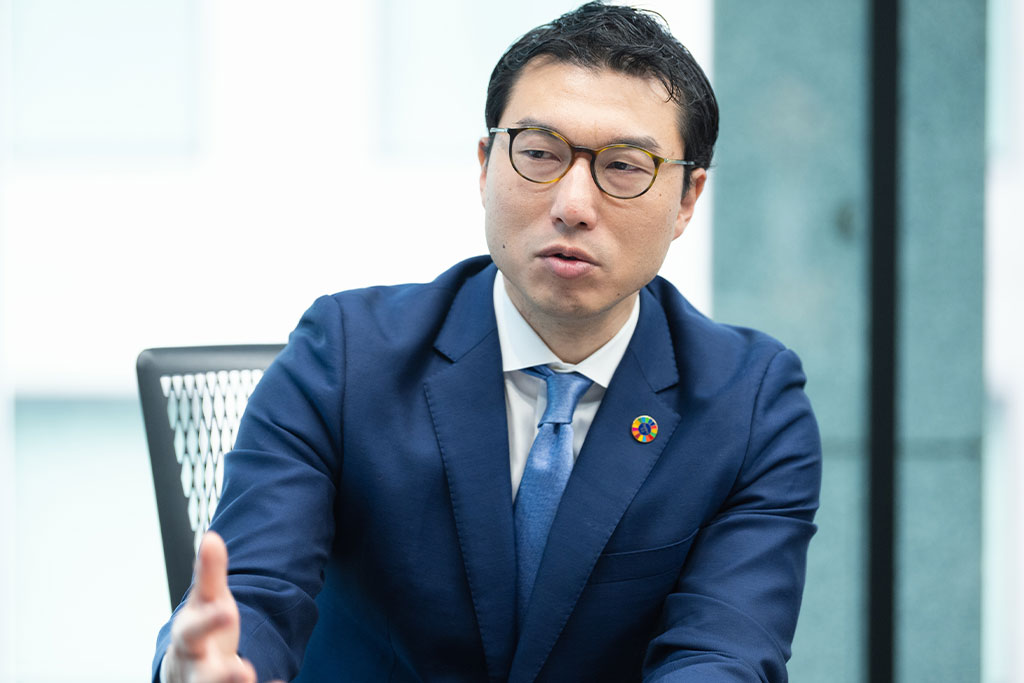
![[Interview] RevComm Inc. × Japan Business Federation (Keidanren): Driving Innovation in the Japanese Economy Through Collaboration Between Startups and Large Corporations Top Image](https://ecosystem.metro.tokyo.lg.jp/wp-content/uploads/2025/04/revcomm-top.jpg)
●Startups to Enhance Efficiency and Productivity in the Japanese Economy
Nishimura: Could you tell me about the circumstances that led to the founding of RevComm Inc.?
Aida: Well, the primary motivation is "improving Japan's productivity." In my previous role at Mitsubishi Corporation, I gained business experience across the globe. During that time, I couldn't intuitively grasp the fact that Japan's productivity was the lowest among the G7 nations. I genuinely questioned whether it was truly that low.
When breaking down productivity, I believe it's "efficiency × effectiveness."Japanese people have high educational standards and strong ethics, so a certain level of efficiency is guaranteed. On the other hand, I felt poor effectiveness was the real issue. Even with high efficiency, low effectiveness lowers productivity.
There are various factors behind poor effectiveness, but I believe one is high communication costs.Personally, I've repeatedly encountered situations where "who said it" mattered more than "what was said." I believed that reducing this communication cost would significantly improve Japan's efficiency. Combined with its high capability, this would dramatically boost productivity.
Driven by this conviction, I decided to launch a business focused on lowering communication costs to enhance Japan's productivity. This was the catalyst for founding RevComm Inc.
●Optimize voice communication
Nishimura: Please tell us about the characteristics and strengths of your company's business.
Aida: The core of our business is voice AI. As I mentioned earlier, we offer services aimed at reducing communication costs.
Why do communication costs become so high? It's because voice communication is a black box.Voice communication occurs in all scenarios—face-to-face, phone calls, web conferences—yet these exchanges are fundamentally confined between participants, invisible to outsiders. Our business uniquely analyzes and visualizes this data using AI to optimize communication and boost productivity.
In the short term, this contributes to PL (Profit and Loss) impact—enhancing corporate profits. But that's not all.We believe another major value lies in the medium-to-long-term balance sheet (BS) impact—contributing to the formation of corporate assets.
Voice data is an extremely important asset for companies, yet it has been largely untapped until now. In the AI era, the fundamental determinant of AI's value is data. Corporate data broadly falls into three categories: voice, text, and images. While text and images have already been transformed into big data, voice data has scarcely been accumulated—this is the current reality.
We aim to transform this into a form that can be utilized as corporate assets. Within the next decade, a new accounting category called "data" will likely emerge. An era will arrive where possessing large volumes of meaningful data will directly influence corporate value itself. Capitalizing audio data and linking it to new cash flow generation. This simultaneous creation of short-term P&L impact and medium-to-long-term BS impact is the defining feature of our business at RevComm Inc.
Nishimura: What is the difference between transcribing audio files and accumulating audio as assets, as your company's service does?
Aida: Recording files and the speech data we handle may seem similar at first glance, but they are fundamentally different. Recording files are things like audio captured by a voice recorder, then run through a transcription engine to convert it into text. This is merely a recording file or transcribed data. However, that alone holds no meaning.
What's crucial is giving the data meaning—tagging. This means information like "when," "who," "what," "how they spoke," and "what happened as a result" must be stored in an organized, linked state.
To achieve this, for example with phone calls, we need to redesign the phone system itself, not just record. This is because standard phone recordings are consolidated into a single monaural track, making it difficult to distinguish "who spoke."Furthermore, since it isn't linked to CRM (Customer Relationship Management) information, details like "what was discussed, with whom, and when" (date, time, participants) aren't organized as data.
Our service addresses these challenges by building from the phone system itself, enabling the utilization of voice data as structured information assets. This is the major difference from conventional recording and transcription services.

●Startups are the most effective mechanism for generating innovation.
Nishimura: Keidanren appears to be actively engaged in supporting startups. What is the underlying rationale behind this?
Kondo: Keidanren is often perceived as simply a "gathering of large corporations," but there was a major turning point. That moment came in 2018 when Hiroaki Nakanishi (former Chairman of Hitachi, Ltd.) assumed the chairmanship.
Mr. Nakanishi, drawing on his experience in Europe and the United States, believed that fostering startup growth was essential to revitalizing Japan's economy.Driven by this conviction, he established the "Startup Committee" in 2019, launching full-scale startup support.
Furthermore, Keidanren itself grew increasingly aware of the need to incorporate the perspective of startups, who will drive the next generation of the economy. It actively expanded its startup membership, and currently, over 100 of its approximately 1,500 member companies are startups.
Another major turning point was the appointment of Tomoko Minami (Chairperson of the Board, DeNA Co., Ltd.) as Chair of the Startup Committee. Under Ms. Minami's leadership, we formulated the "Startup Advancement Vision." At its core lies the belief that "startups are the most effective mechanism for generating innovation." To establish this vision in Japan, Keidanren must take the lead and accelerate its support for startups.
※1 The "Startup Advancement Vision" is a proposal compiled from a perspective transcending corporate size, history, and positions such as industry, academia, and government. It aims to realize an ecosystem where the base of startups in Japan expands dramatically while simultaneously fostering numerous startups that achieve global success. (Website: Keidanren: Startup Advancement Vision (2022-03-15) )
Nishimura: The "Startup Advancement Vision" was announced in 2022, but what specific support measures are being implemented?
Kondo: Our activities are centered around three pillars. The first is policy advocacy and its implementation. We work to translate the measures outlined in our Vision for Advancement into actual policies and bring them to fruition in concrete form.
The second is promoting collaboration between large corporations and startups. This is an ongoing initiative since the Startup Committee's inception, where we operate the "Keidanren Innovation Crossing (KIX)" pitch and networking event. Its defining feature is limiting Keidanren (large corporation) participants to decision-makers at the department head level or above. This provides startups a direct dialogue platform with the decision-making tier, fostering highly effective partnerships.This mechanism is also highly valued by the startups themselves.
Third is promoting behavioral change among large corporations. Large corporations still hold significant sway in the Japanese economy, making it a critical challenge to leverage their assets for startups.To address this, we introduced the "Startup-Friendly Scoring" system. This system assigns scores to participating companies based on metrics such as how much they provide assets to startups, how much they incorporate startup technologies and ideas, and how much they contribute to the ecosystem. The scores are then publicly disclosed. This makes the startup support efforts of large corporations visible and encourages further behavioral change.
●Startup Growth and Scale: We must increase the "height" of the "10x10x" model.
Nishimura: Three years have passed since the proposal of the "Startup Advancement Vision." How would you assess the three years starting from 2022, Mr. Kondo?
Kondo: Among the goals outlined in our Vision for Leap Forward is the "10X10X" initiative. This aims to increase the number of Japanese startups tenfold and raise their success rate tenfold, targeting achievement within five years. We are now approaching the halfway point.
Over the past three years, the base of startups has definitely broadened, and their numbers have increased.However, we have not yet reached tenfold growth, and a major challenge is how to increase the "height" of success. There are also observations that IPO sizes tend to be small, making it difficult for large-scale startups to grow.
We believe that revitalizing the deep tech sector, including AI, is key to increasing this "height." Therefore, last September, we released a proposal called "Science to Startup," specifically focused on university-spinoff deep tech startups.Japanese universities still conduct numerous world-class research projects, and we believe focusing on this field is essential moving forward. Furthermore, the government has actively embraced our proposal and implemented cross-cutting policies to support startups. We strongly hope that even with the change in administration, these efforts will not be scaled back but will continue to be promoted. Keidanren will also continue to advocate for this.
※2 "Science to Startup" refers to the "10X10X" goal set forth in the "Startup Leap Forward Vision" proposal (March 15, 2022), aiming to increase both the number of startups and their level of success tenfold by 2027.Approximately two years have passed since the government adopted this shared goal. Supported by government policies, the number of startups has shown a steady upward trend. However, the number of unicorns has not increased. To identify further measures and elevate the level of success, Keidanren compiled this proposal, focusing on Japan's strengths in outstanding research and technology. (Website: Keidanren: Science to Startup (September 17, 2024) )
Nishimura: I'd also like to ask Mr. Aida about this. In 2022, Keidanren announced its "Startup Advancement Vision," and subsequently, Prime Minister Kishida unveiled the "Five-Year Plan for Startup Development." Over these past three years, it seems like we've been hearing the term "startup" much more frequently. Looking back over these three years, do you feel any changes compared to before?
※3 The "Startup Development Five-Year Plan" is a strategy formulated at the 13th New Capitalism Realization Conference on November 28, 2022. The government designated 2022 as the inaugural year for startup creation and presented a strategy and roadmap to significantly increase the number of startups within Japan.This plan aims to increase investment in startups by more than tenfold by 2027 and ultimately create 100,000 startups. (Reference: Five-Year Startup Development Plan )
Aida: While participating in Keidanren's framework is certainly valuable, I also feel that opportunities for dialogue with large corporations are increasing, opening doors for startups. However, when considering the "10X10X" goals, I feel the "vertical 10" – meaning the growth speed and scale expansion of startups – is overwhelmingly insufficient.
Frankly, when considering the impact on the Japanese economy as a whole, simply increasing the number of startups (horizontal 10) is unlikely to bring about significant change.What's truly needed is to create and nurture large-scale companies.
For example, other countries invest national funds into already growing companies to support their scaling up. In contrast, Japanese policy focuses primarily on early-stage support. Once a company enters the growth stage, it's often abruptly pushed aside with the attitude, "You've grown enough now, so you don't need support anymore, right?"
However, given that Japan's GDP exceeds 500 trillion yen, the impact on the economy will be minimal without a strategy capable of creating at least 10 "decacorns" (companies valued at 1 trillion yen). Therefore, I believe it is crucial to significantly strengthen support for startups in the growth stage. "How do we create large-scale companies and make them globally competitive?" – This is arguably the biggest challenge for Japan's startup support going forward.
Nishimura: For startups like yours, do you have any specific ideas about support measures that would make it easier to aim for decacorn status?
Aida: Rather than speaking for individual companies, I'd like to address this from a broader perspective. One significant potential opportunity lies in leveraging public procurement. For example, Tokyo's annual budget is 16 trillion yen. That means Tokyo alone conducts 16 trillion yen worth of public procurement annually. What if we allocated just 10% of that (1.6 trillion yen) to startups?
Currently, the enterprise value multiple relative to sales for IPO companies is around 3 to 5 times.Applying this, a simple calculation suggests a potential market value equivalent to 5 to 10 trillion yen. This means the potential to create several decacorns and dozens of unicorns in just one year. Furthermore, expanding this approach nationwide and across all local governments could easily generate an impact worth 100 trillion yen. That, I believe, is what leveraging means. If such initiatives progress, wouldn't Japan as a whole achieve dramatic growth while also mitigating the digital deficit currently seen as a problem?
Kondo: The Startup Advancement Vision also mentions expanding public procurement.Currently, the procurement target for startups is set at 3%, but the Vision calls for raising this to 10%. Achieving this should have a significant impact.
As Mr. Aida mentioned, even Tokyo alone can have a substantial effect. Furthermore, if we can create a cross-regional system where "products procured by one municipality are also utilized by another," wouldn't this further accelerate the flow of funds to startups?
Aida: Japan has approximately 1,700 local governments. For example, our company has been implemented in Tokyo for over four years. I strongly feel intuitively that if we can create a flow where "solutions adopted in Tokyo are rolled out to local governments nationwide," it would create tremendous impact.
Especially since many areas of local government DX (digital transformation) are still lagging, there is enormous potential for startups to contribute. This benefits both the residents of the municipalities and the municipalities themselves. Furthermore, it fuels the growth of startups, which in turn pleases the investors supporting them. I believe we can create a system that truly benefits all parties involved.
Nishimura: That's certainly true. As the Tokyo Consortium Secretariat, we've reaffirmed our role in promoting implementation within Tokyo while also actively expanding the initiative to other municipalities.

●Whether opportunities can be leveraged
Nishimura: Now, going back a bit, could you tell us about the circumstances and background behind your company joining Keidanren?
Aida: The biggest reason is to gain social credibility. While our transactions with large corporations are increasing, we haven't yet become a public equity company (IPO). Whether a company has gone public often becomes a key criterion for judgment. However, I don't believe being listed inherently demonstrates a company's true capabilities.
In this context, being able to say "We are a Keidanren member company" provides significant credibility. This makes it easier to conduct business with large corporations and increases opportunities for dialogue. It also makes it easier to have our voices heard at economic meetings, enhancing business trustworthiness. In practice, when asked, "Is your company a member of Keidanren?" and we can respond, "Yes, we are honored to be part of it," it serves as a valuable starting point for building relationships.
Nishimura: You're truly making effective use of Keidanren's assets. Many startups struggle with a lack of social credibility, so I feel a strong affinity for the relationship with Keidanren.
Aida: While connections with large corporations naturally increase, I personally make active use of the committees. For example, at the Indonesia Committee I recently attended, Takehiko Kakiuchi, Chairman of Mitsubishi Corporation—my former employer—served as Chairman. This provided an opportunity to make direct proposals to the Indonesian government right there.
Our company also operates in Indonesia. Seven years ago in Japan, the government declared the "Cloud by Default Principle," establishing a policy to utilize cloud services in public procurement. This prompted a mass shift to the cloud, even among large corporations and banks. Drawing on this successful model, I was able to directly convey to the Indonesian government, "Why not introduce Cloud by Default in Indonesia too?" And I did so right beside Mr. Kakiuchi.
※4 The "Cloud by Default Principle" is stipulated in the "Basic Policy on the Use of Cloud Services in Government Information Systems" announced by the government in June 2018. It refers to the policy that "regarding the construction and maintenance of government information systems, the use of cloud services should be considered the first option (default)." (Reference: "Digital Society Promotion Standard Guidelines DS-310: Basic Policy on the Appropriate Use of Cloud Services in Government Information Systems" )
Under normal circumstances, people might think, "Who does that young upstart think he is?" But even then, they'll listen to what you have to say, and discussions will start with comments like, "That's interesting." The very "space" for such proposals has been almost nonexistent for startups until now. However, by utilizing Keidanren's committee, that "space"—that opportunity—exists.
Ultimately, whether startups can capitalize on these opportunities depends entirely on them. The door is open; the key now is how proactively they can seize these chances.
![[Dialogue] Scene from the Dialogue between RevComm Inc. and the Japan Business Federation (Keidanren)](https://ecosystem.metro.tokyo.lg.jp/wp-content/uploads/2025/04/revcomm06.jpg)
● Innovation born from collaboration between large corporations and startups
Nishimura: Moving forward, I'd like to hear your thoughts on the future. First, I'd like to ask Mr. Aida: What do you expect from Keidanren to help Japanese startups grow further?
Aida: I believe it would be highly significant if you could advance initiatives that further promote the integration of large corporations and startups. A fundamental challenge is the asymmetry of information. Often, startups and large corporations do not fully understand each other's strengths and potential.
For example, Keidanren could serve as a hub to provide matching opportunities. Alternatively, even without directly acting as a hub, they could actively disseminate case studies showing "what kinds of initiatives startups and large corporations have undertaken, what innovations emerged, and what economic impact these had."
If such success stories become visible and more companies think, "If there are such success stories, maybe our company should try partnering with a startup too," collaboration with startups would accelerate, creating a flow where new innovations emerge one after another.
If that happens, it might sound a bit far-fetched, but I believe it could create a chain reaction, like the old saying "When the wind blows, the barrel maker profits," potentially invigorating M&A activity.
For example, wearing appropriate attire, exchanging business cards correctly, researching the person's years of service or hometown beforehand to make small talk about it – mastering these subtle manners can make conversations flow more smoothly.
I feel that interactions with large corporations through Keidanren serve as a place to learn and adapt to this "corporate culture." While startups and large corporations use vastly different languages and cultures, if these barriers dissolve through such venues, large corporations might think, "Startups aren't so bad after all," and startups can more easily understand corporate logic and etiquette.
As a result, collaboration naturally emerges with a "Let's work together" attitude. Furthermore, when M&A occurs, the startup's understanding of corporate protocols facilitates smoother PMI (Post-Merger Integration).
If this system functions well, it should reduce cases of "We did an M&A on a whim, but it didn't work out..." and invigorate the M&A market itself.
Nishimura: Regarding Mr. Aida's comment just now, what are your thoughts, Mr. Kondo?
Kondo: I was just thinking I needed to touch on M&A. Over the past decade or so, CVC (corporate venture capital) activity has become more active, and investment amounts have been accumulating. However, what I feel through our scoring efforts is that collaboration between large corporations and startups often remains superficial.
Specifically, I feel companies haven't yet sufficiently reached the level of actively utilizing startup technologies and services within their core businesses. This connects to the earlier discussion on public procurement, but private sector procurement also has many areas that remain inadequate.
For example, it's crucial for mechanisms like the "Venture Client Model" – which test startup technologies early and adopt them quickly – to become more widespread within large corporations.Beyond that, I believe a future awaits where more substantive collaboration progresses, ultimately leading to a natural increase in M&A.
That is precisely why Keidanren also aims to promote support that effectively connects the core businesses of large corporations with startups.
Aida: That's truly wonderful. For instance, if initiatives like Dai-ichi Life's "Benefit One" increase, I believe it would have an incredibly positive ripple effect. Furthermore, cases like Mr. Minami (Soichiro Minami), founder of Bisreach, now serving as an outside director at Marubeni, show that recently, startup entrepreneurs are increasingly joining large corporations as outside directors.
※5 Benefit One is a comprehensive employee benefits service offering preferential access to over 1.4 million services. These span dining, leisure, shopping, learning content like e-learning, childcare and nursing care, moving, and other life event-related services. Approximately 16,000 organizations have adopted the service, with around 11 million members (as of April 2024). It offers support menus to enhance employee satisfaction, promote health management, and encourage skill development. Dai-ichi Life Holdings made Benefit One, which handles corporate welfare administration services, a wholly-owned subsidiary. This created a service combining Dai-ichi Life's life insurance and Benefit One's welfare platform with the medical and health domain, an area Dai-ichi Life aims to focus on.(Reference: Benefit Station | Benefit One Inc., "Regarding the Full Subsidiary Acquisition of Benefit One Inc." )
Startup entrepreneurs can offer candid opinions about large corporations' management without reservation. I believe this stance brings fresh perspectives to large corporations, ultimately increasing the likelihood of more productive collaborations and successful M&A deals.

●Fearlessly taking on challenges beyond one's means
Nishimura: Mr. Aida, what role do you believe startups should play in enhancing Japan's international competitiveness?
Aida: Earning foreign currency. The biggest challenge is that we aren't earning foreign currency in the software and technology sectors. Intangible goods, especially software, have high gross profit margins and generate cash flow easily. As a result, corporate value tends to increase, allowing for greater leverage. However, Japan is currently lagging behind in this area.
To overcome this challenge, I believe it's essential to go overseas.Of course, thorough planning is important, but I also feel a certain kind of "recklessness" is needed. Without being overly cautious, let's challenge overseas markets with a "Go Bold" spirit—isn't that the mindset Japanese startups need?
Nishimura: To enhance competitiveness, what initiatives does your company plan to pursue going forward?
Aida: We are currently expanding into Indonesia and the United States, but I believe the key is to "continue taking on challenges beyond our current capabilities." The large corporations that have driven Japan's economy have also grown by taking risks and boldly challenging themselves. As a startup, I believe we should maintain that same spirit.
Specifically, we will expand beyond Indonesia into other Southeast Asian markets like Thailand, Singapore, Malaysia, and the Philippines. In North America, we will move beyond the United States to broader regions. Crucially, we must maximize sales and cash flow in each country and translate that into enterprise value.
Currently, the majority of our revenue comes from the Japanese market. Structurally, this is disproportionate when viewed relative to global GDP. Going forward, we consider building a structure where over half of our revenue is generated in global markets to be our most critical mission.
●If you don't see it through, no strategy will amount to anything.
Nishimura: Is there anything you'd like to emphasize again in your own words, Mr. Aida?
Aida: It's all about determination and grit. Ultimately, what matters most is the resolve to never give up. The challenges are already clear, and the approaches to tackle them are somewhat visible.What remains is whether we see it through. Without seeing it through, no strategy holds meaning.
This isn't just about startups. I believe everyone—large corporations, the Keidanren watching over them, and the Japanese government—must possess the resolve to see things through. Without this resolve, Japan will simply continue to decline. To prevent that, isn't the spirit and action to "see it through" precisely what is being demanded right now?
Nishimura: "See it through." That's exactly what our generation must strive to do. Mr. Kondo, if there's anything you've reaffirmed through our discussions so far, or any message you'd like to convey, please share it.
Kondo: First, I sincerely appreciate Keidanren's active support. I also hope other startups will follow Mr. Aida's example in effectively utilizing Keidanren's framework to create growth opportunities.
Our mission is to continuously provide opportunities for startups to connect with large corporations and generate new chances. I truly hope many will take advantage of this platform.
Nishimura: Finally, for those considering applying to the Tokyo Consortium, we'd like to hear a message from Mr. Aida.
Aida: I guess it comes down to determination and grit, huh? (laughs) Half-joking aside, what truly matters is "how we can be useful to society." To achieve that, I believe trust is paramount.
Business thrives on a trust-based economy. That's precisely why it's crucial to become an entity supported by third-party organizations and support groups like the Tokyo Consortium and Keidanren.But that's just the result. First, we must genuinely engage with our own business and contribute to society. It's precisely because we have that attitude that supporters around us increase.
And how we leverage opportunities is also crucial. If a chance presents itself, will we go for it? While receiving support, I want us all to aim for significant growth together.
Share the article