![[Interview] Leading the Way in Infrastructure Inspection DX with Cutting-Edge Technology](https://ecosystem.metro.tokyo.lg.jp/wp-content/uploads/2024/10/sensyn-top.jpg)
Integration of Applications, Platforms, and Data
Nishimura: Your company provides solutions tailored to each customer’s specific challenges based on EN core technology, EN CORE. However, I imagine this explanation alone may not fully convey what it entails, so could EN please tell us about the benefits of EN CORE and how you apply it for your customers?
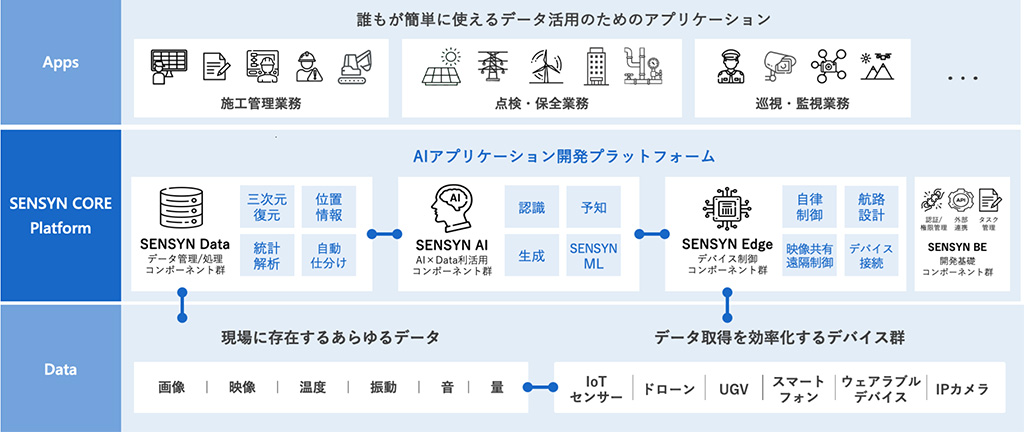
Kitamura: Please take a look at this architecture.In our business, we control smart devices and utilize the data collected from them to gain insights that enable us to detect anomalies and irregularities. To achieve this, we provide business applications that are easy to operate even for end users with limited IT literacy and can be effectively utilized over the long term. In addition, we own EN CORE Platform, which allows us to extract and utilize data with a high degree of reproducibility. We combine applications, platforms, and data to develop optimal solutions.
Nishimura: Could you please explain in more detail what the EN CORE Platform EN just EN is?
Kitamura: The EN CORE Platform offers three main functions. The first is EN Edge, an edge computing technology designed to control the smart devices I mentioned earlier. When collecting data such as images, video, and temperature readings in environments that are harsh for humans or at high-risk sites, it is necessary to automatically operate tools such as drones, various robots, and smart devices. EN Edge makes this possible.
The second is a cloud service EN. When data collected by smart devices is uploaded to our cloud service, it is linked to image and map data, reconstructed in 3D, and organized chronologically with metadata. As this data accumulates, it becomes big data that can be used for statistical analysis.
EN third EN, analyzes this data.This enables the automatic detection of abnormalities and changes, such as rust and cracks, supporting preventive and predictive maintenance. Ultimately, it reduces the need for sudden repairs and minimizes abnormalities, supporting management decisions such as planned maintenance. EN AI is also used as the control technology for EN, and we position AI as our core technology.
In this way, we provide solutions by leveraging three key technologies: edge technology, data technology, and AI.
We want to be partners who solve challenges together.
Nishimura: With so many competitors in the market, could you tell me what you consider to be your company's particular strengths or the points where you believe you excel compared to others? Of course, I believe you excel overall, but I'd especially like to hear about your unique aspects.
Kitamura: One of our company's strengths is that we place great emphasis on our customers' business processes and data flow. These are broadly divided into three steps. First is acquiring the data. Second is analyzing and interpreting that data. And third is utilizing that data to make an impact on actual operations and society.
Manufacturers selling devices like robots and drones, or companies specializing in this field, often tend to fixate on the first step: data acquisition. Driven by the desire to sell products, they easily fall into approaches like "It's safe if it moves instead of people" or "Let's buy and try it first." However, we do not take such an approach.First, we identify the areas where we can make an impact on operations. We formulate hypotheses about the challenges present and the impact solving them would have, measuring this impact both quantitatively and qualitatively. We believe this method is meaningful both operationally and socially. To do this, we need to determine what insights are required and pinpoint the sources where the data needed to extract those insights originates.
If acquiring data from the air is optimal, using drones is an option. However, drones carry the risk of crashing during flight, and we have indeed dropped them several times during testing. Therefore, in environments where such risk is unacceptable, we use ground-based robots. Furthermore, when simpler methods are more suitable and high-tech equipment isn't necessary, we may utilize network cameras or smartphones. In this way, we remain flexible regarding hardware choices, not bound to any specific solution.We believe in leveraging the best available technology worldwide, and in some cases, manual data collection by people is perfectly acceptable.
Our ultimate goal is to make a tangible impact on operations and, by extension, contribute to society. Few companies handle the entire process from data acquisition to analysis and utilization. Our ability to provide this end-to-end service is a major strength. This capability is highly valued, leading to the adoption of our solutions in numerous field applications.
Nishimura: I understand perfectly. From what you've shared, it seems you're taking more of a backcasting approach than a forecasting one. In other words, you first thoroughly discuss and pinpoint the ultimate outcome you want to achieve, then determine how to gather the data needed to reach that goal. In that sense, the ability to truly listen to the client, identify the real issues, and discern the core questions—in other words, your consulting skills—become absolutely crucial.
Kitamura: That's a very important point, but you shouldn't directly ask the customer, "What's your challenge?" While that might be standard practice in general solution sales, the moment the customer answers, "This is our challenge," they may already have shared the same story with other companies.
Nishimura: I see. So, at that point, the issue has become apparent.
Kitamura: That's right. When it comes to apparent issues, customers tend to think any company will do as long as the price is low and the features are robust.
Nishimura: That's certainly true.
Kitamura: We must not become just another vendor. Our goal is to be a partner who identifies challenges alongside our clients. To achieve this, we first propose hypotheses. For example, we suggest, "Given this business model, wouldn't you say these are the kinds of challenges or pain points you face?"This leads to a conversation where the customer either responds with, "Yes, that makes sense," or says, "That might not be us, but perhaps the department next door faces such challenges." The discussion expands. Once the challenge is shared and the conversation flows to "So, how can we solve this?", our past achievements and evidence become valuable reference materials. We place great importance not just on making proposals, but on being recognized as a partner who identifies challenges together with the customer and solves them together.
Nishimura: So it's about accompanying our clients and discovering challenges and questions together.
Kitamura: That's right. If we force our products on them, we can't become true partners.
Nishimura: In that sense, how is the initial contact typically made?
Kitamura: Lately, we've been getting a lot of word-of-mouth referrals. That's what makes me happiest.
Nishimura: That's definitely the best.
Kitamura: We're increasingly getting inquiries from other departments within our clients' organizations asking, "We heard you're doing this kind of thing—what's your take?" and even from competitors in the same industry saying, "We've heard rumors—we'd like to try it ourselves." Surprisingly, information tends to spread quite a bit, especially within capital-intensive industries. While we visit many companies ourselves, word-of-mouth remains our most effective way to achieve high success rates.
Nishimura: After all, pull is more effective than push.
Promoting the democratization of tools
Kitamura: Until now, we were often perceived as "a drone company," primarily because drones are exceptionally capable and serve as a convenient tool for data acquisition. However, drones alone cannot accomplish everything. We have steadily expanded our other capabilities, automating control of these tools through our platform to advance their "democratization"—making them accessible and safe for anyone to use, regardless of skill level.
As a result, we've accumulated vast amounts of data. We're now moving into the phase of leveraging that data to create impact. We're particularly focused on the AI domain. While we've always had an AI team, it's only in the last year or two that it's truly begun to function effectively.
To give a concrete example of the impact we're making, consider wind turbine blade inspections.We assess the level of cracks or rust. For instance, if it's Level 2, we might decide monitoring is sufficient. But if it's Level 4 or higher, we initiate an inspection process—even if it involves high or hazardous locations—where humans then directly access the tower via rope access. If actual repairs are needed, we proceed to order parts or coordinate repairs with partner companies.We also use AI for various other infrastructure inspections, such as detecting cracks in building facade tiles or concrete, inspecting power equipment like wires and towers, and identifying loose bolts.
Additionally, we handle automatic readings of pressure gauges within plants and, uniquely, spark detection in steel mills.At steel mills, safety supervisors are always present to prevent fires caused by sparks generated during iron processing. However, humans can miss sparks. Therefore, we built a system that triggers an alert when sparks exceed a certain threshold.Furthermore, by recording several tens of seconds before and after the alert, we can capture evidence usable for training and review.
Thus, while our entry point is typically equipment inspection and maintenance, numerous risks and analog areas exist around these operations. Our goal is to listen closely to the risks and challenges our customers face, then not only implement systems using drones or robots, but also execute purely software-based solutions where possible. We aim to leverage data to deliver tangible impact on our customers' operations.
Nishimura: So, equipment inspections are merely the starting point. We use them as an opportunity to build closer relationships with our customers, solve their challenges, and work together to advance their DX initiatives.
The coexistence of AI and humans is the direction we should aim for.
Nishimura: This might be a rather basic question, but could you tell us about the accuracy of information gathering using drones and other digital or smart devices? I imagine everyone is curious about how accurate they are. Ideally, they'd reach a level where human oversight becomes largely unnecessary. But even if human input is still required, can we understand that current smart device-based image diagnostics have advanced to the point where AI can handle most decisions independently?
Kitamura: AI still can't match the human eye. Humans possess an exceptionally high ability to use their five senses, like smell, for example. AI and robots are single-point focused, so they can't beat humans in that area. However, in terms of endurance and the ability to perform the same task continuously with consistent precision, AI and robots are overwhelmingly superior.
Customers often ask, "Wouldn't humans achieve higher precision?" They say, "If it's more precise than humans, we'll consider implementing it." But in reality, humans don't consistently maintain that high level of precision. Mistakes happen, and fatigue causes blurred vision. Furthermore, precision can change as people age. Considering this, AI holds the advantage on average.
Nishimura: While human eyes may occasionally outperform machines in specific situations, in terms of delivering consistently stable performance, implementing such solutions is absolutely essential in Japan, where the population is aging and birth rates are declining.
Kitamura: That's right. People have long said it's about "instinct, experience, and guts (KKD)," but comparing that to AI is meaningless. The goal is to have AI handle that and standardize it as much as possible. So, the argument that it must be nearly 100% accurate isn't very effective. Sometimes, even at 70%, it's better if it can consistently perform tasks with the same level of accuracy. Having that kind of discussion is what's important.The question of "what percentage accuracy?" misses the point entirely. What matters is the coexistence of machines and humans.
Nishimura: I see. It's true that when you pursue 100% perfection, there are moments you simply can't catch everything. The ideal is to correctly recognize human limitations and shortcomings, and have machines and humans coexist—machines that can work 24 hours a day with consistent performance, and humans whose five senses complement each other. It's important not to view them as opposites, but to see them as working together.
Kitamura: That's right. As I often say, I believe robots and AI should collaborate with humans. Take power transmission towers, for example—there are thousands of them. If AI could identify just ten that require careful human inspection to ensure safety, productivity would skyrocket. Ideally, AI should handle that screening role.
Nishimura: That's a very important message. It's true we tend to get caught up in an all-or-nothing debate about machines doing everything.
Kitamura: Yes. I believe that not only in this industry, but in other technologies as well, the greatest value is realized when people and machines collaborate.
Nishimura: You mentioned durability as one of AI's strengths earlier. Could you elaborate on that?
Kitamura: Humans get tired, but AI doesn't. For example, when drones or robots photograph objects, they gather hundreds, sometimes thousands, of images at once. It's incredibly difficult for humans to check each one individually—and frankly, we wouldn't want to. That's precisely why automation is essential; otherwise, we simply can't keep up with the processing.Conversely, while humans might intuitively judge "This area seems fine" or "This looks suspicious" and move on, having people analyze the data means meticulously checking every single image, significantly increasing the workload. That's precisely why we need a system that automatically identifies anomalies using AI. Doing so might compensate for areas humans overlook and enable the detection of anomalies humans couldn't find.
Nishimura: Even if drone-based data collection becomes automated, it's impractical for humans to analyze thousands of images afterward. That's why combining it with AI allows us to effectively utilize the data.
Kitamura: That's exactly right. Many companies actually collect data but leave it untouched without processing it. Even if they use tools to gather data, if it's just stored in large quantities on hard drives, customers can't utilize it for inspections.
Accelerating the transition to CBM for a sustainable future
Kitamura: So the first thing we tackled was creating a system to automatically link collected data to its location of capture, giving the data meaning. We linked it to a map so we could see where it was taken. This allows us to visually grasp data corresponding to specific locations. On top of that, we enabled the automatic classification of hundreds or thousands of data points per location and the use of AI to detect anomalies.
When dealing with big data, identifying trends becomes crucial.For example, predictions like "We might be able to reduce inspection frequency for this part" or "This machine is likely to fail soon." It also enables proactive planning, such as "We have the time and capacity now, so let's perform maintenance proactively." This fundamentally changes how work and maintenance are conducted. Tasks that previously required hundreds of people might now be handled by just dozens. This approach holds potential to counteract labor shortages.
Currently, a shift from TBM (Time-Based Maintenance) to CBM (Condition-Based Maintenance) is required. TBM refers to maintenance performed at fixed, predetermined intervals. However, this method leads to insufficient resources. There is simply too much aging equipment for scheduled maintenance alone to handle. Consequently, maintenance becomes inadequate, increasing the risk of equipment failure during disasters or accidents.
On the other hand, CBM is an approach that monitors equipment condition in real time, detects signs of impending problems, and takes early countermeasures. It allows for the preemptive identification of hazardous areas and planned responses. I believe transitioning to this condition-based maintenance can help build a more sustainable future.
Nishimura: Switching from TBM to CBM is quite a significant undertaking.
Kitamura: That's right. They say it can't be sustained otherwise.
Nishimura: So your company is taking a proactive approach to that, right?
Kitamura: Yes. Just talking with our customers, it's clear that the working conditions on-site are extremely harsh.
Nishimura: It's clearly harsh, isn't it?
Kitamura: That's right. Since many jobs involve what's known as the "3K" (hard, dirty, dangerous) work, the reality is that few people actively choose to enter this industry if they have other options. If there are jobs that pay better and aren't 3K, people will naturally gravitate toward those. That's precisely why I believe it's crucial to replace these harsh, high-risk jobs with new technology. Doing so could attract new talent eager to work using this technology.In fact, initiatives using robots and AI to modernize infrastructure and legacy sectors are highly appealing to STEM professionals. An increase in such talent could help alleviate labor shortages in different ways. We aim to pursue these efforts while also anticipating such secondary benefits.
Nishimura: When I visited your company's website, I also saw news about you launching a drone academy-like initiative. It gave me the impression that by increasing the number of drone operators, you aim to further broaden the scope of your business.
Kitamura: Actually, we’re planning to incorporate the content I just mentioned into the academy. There’s a reason we named it the EN ROBOTICS ACADEMY” rather than simply the “Drone Academy.” For the first phase, we’re focusing on drones to align with the national certification system, but we don’t want to limit ourselves to that. We want to create a space where we can share our know-how and experience—including both the successes and failures we’ve accumulated over the years.Although we haven’t offered this in an academy format until now, we actually conduct a great deal of training and education for our customers throughout the year. We launched this initiative because we believe that expanding these efforts more broadly will further enhance our social value. Going forward, we plan to teach applications across various fields—not just drones, but also AI and other robotics technologies—and provide the necessary training.
Nishimura: I see. So the idea is to increase the number of people who share the same aspirations and perspective.
Challenges and Potential of Overseas Expansion
Nishimura: Could you share your challenges and strategies for expanding your client base going forward? You're already working on overseas expansion, right?
Kitamura: That's right. Overseas, the biggest challenge is the significant differences in regulations between countries. Naturally, laws vary by country, and often rules and customs aren't explicitly stated in the laws.
Nishimura: That's true. Cultural norms and customs vary from country to country.
Kitamura: That's right. If such matters are handled incorrectly, there's a risk of being misunderstood as a terrorist act and arrested. Infrastructure is a national asset, so expanding overseas alone carries significant risk. We still need partners familiar with local conditions. Finding such partners is our challenge and also our mid-to-long-term strategy.
Nishimura: What specific roles do you expect from your partners? For example, in which areas do you expect them to contribute—such as developing sales channels, finding new customers, or securing the supply chain?
Kitamura: Ideally, we want to be able to collaborate directly with the local customers themselves.Similar to Japan, overseas markets face challenges beyond risk reduction and labor shortages—including technology standardization and engineering resource shortages. We aim to advance digitalization that addresses these needs. That's one major goal.
However, this alone exposes us to risks unique to overseas markets. Partnering with companies that deliver equipment and devices locally is also crucial. These partners deeply understand local rules and customs, having been involved in maintenance for years. Leveraging such partnerships is key to mitigating risks.
Nishimura: That's exactly right. The Tokyo Consortium is pursuing a similar strategy, approaching companies in Japan that already have overseas business relationships and implementing a method aimed at local expansion. Also, regarding the long lead times often cited as a challenge for overseas expansion—this isn't a problem unique to overseas markets, is it?
Kitamura: That's right. The larger and more complex the industry, the slower the project progress tends to be. It requires risk management and operational adjustments on the client's side, as well as approvals from all involved parties and ensuring safety. While I understand that, honestly, it sometimes feels too slow. That's why we actively issue press releases every month to accelerate the process and deepen understanding.
Nishimura: It takes courage to issue a press release for something that's still a new initiative.
Kitamura: That's right. While there is a risk of being imitated, more than that, we take pride in being a market maker who creates the market. We believe gathering allies and gaining customer empathy is paramount, so we proactively share information.
Nishimura: That point connects to what we were discussing earlier about the academy.
Kitamura: That's right.
Nishimura: The role of a market maker really clicked for me.
Kitamura: We have to create the market ourselves, after all.
Nishimura: Do you notice any differences in how discussions progress domestically versus internationally? Since your company operates in both markets, I'd be interested to hear about any distinctions you've observed.
Kitamura: At first glance, doesn't it seem like overseas companies make decisions faster?
Nishimura: Yeah, that's a good one. "Like" seems like it would be decided right away.
Kitamura: But actually, it's not that fast (laughs). In fact, it can be slow sometimes. It's not much different from Japan.
Nishimura: I see. I had this impression that Japan was significantly behind.
Kitamura: For instance, if it's something like introducing ChatGPT, we might decide immediately. But when it comes to protecting infrastructure, we become cautious. Failure isn't an option, and if an incident occurs, we'll be held accountable.
Nishimura: Where exactly does the process slow down? Even if the message gets through during the door-knocking phase, is there a stage afterward where progress stalls?
Kitamura: That's right. It's a challenge we face too. For example, with robot-based solutions, which hardware to use is a major issue. Since we can handle it with software, having compatible devices is sufficient. However, there are questions like whether devices available in that country are usable and whether the protocols will work. The key lies in whether this hardware-software combination can be implemented locally, and adjusting that takes considerable time. Communication bandwidth also comes into play.
Nishimura: I see. So device settings are a major factor, huh?
Kitamura: That's right. Furthermore, we need to find players who can handle maintenance locally.
Nishimura: We'll also need people to handle maintenance and upkeep, right? That definitely sounds like it would take a lot of time.
Kitamura: That's exactly it. It would be ideal if we could handle everything just with PCs and smartphones, but economic security and infrastructure issues also come into play.
Supporting efforts toward decarbonization
Nishimura: We've been supporting you as the Tokyo Consortium up until now. Frankly, what are your thoughts?
Kitamura: We worked together on a decarbonization simulation, right? We had them calculate, based on the Ministry of the Environment's standards, whether our solution could truly be effective for decarbonization and, if so, what kind of impact it would have. The results confirmed that it does indeed produce results. Of course, that alone won't guarantee our solution gets adopted, but I believe it's highly significant that it has positive effects as a secondary benefit.Going forward, companies will likely need to disclose CO2 reduction efforts in their securities reports. Additionally, I believe this will be a factor that earns positive evaluation from investors from an ESG management perspective. In that sense, I'm extremely grateful that we now have this foundational data in place.
Nishimura: I'm glad to hear you say that.
Kitamura: Honestly, that kind of work is a pain, isn't it? It's such a mundane task.
Nishimura: No, no, that's our job.
Kitamura: But it really helps to have someone skilled in that area. They can combine various data points to draw conclusions. You could probably force your way through it, but there aren't many people who are good at and enjoy that kind of work.
Nishimura: That project would have been the best-case scenario if the investment had come through, but things just don't go smoothly, do they?
Kitamura: Even so, I was impressed by that result. It really does have such a positive impact. But that doesn't mean our solution will necessarily be adopted because of it, though (laugh).
Nishimura: Well, that's just a secondary effect, I suppose (laugh).
Be the player they turn to first
Nishimura: As you take on the role of a market maker, how do you envision developing Senshin Robotics moving forward?
Kitamura: First, as we've communicated company-wide, we aim to be the first player people think of and consult when using drones or robots for infrastructure maintenance and preservation.
Our value lies not in simply proposing solutions when consulted, but in identifying the true challenges, presenting the optimal solution in the shortest and fastest way possible, and supporting execution—as I mentioned earlier. To achieve this, while we still have areas needing improvement, we constantly strive to incorporate cutting-edge technology.While we've recently integrated these into our operations, our strategy heavily relies on quickly adopting technologies like LLM (Large Language Models) and generative AI—which have high affinity with our work—and delivering their benefits to our clients.
Looking at our client relationships, we've already reached many owner companies with extensive facilities. We now aim to extend the wave of digitalization to their affiliated companies. This is incorporated as one of our growth strategies.
Nishimura: What kind of companies are these affiliates, specifically?
Kitamura: For example, the owners of facilities like power companies, steel mills, and oil plants are the companies that hold the assets, but the companies that build them are engineering firms and construction industry companies. These companies place orders for numerous components and have various contractors coming and going.
Nishimura: So the idea is to expand it to all ecosystem players.
Kitamura: Our customer base is extremely broad. While we've targeted the top of the pyramid thus far, we believe that if we can influence the entire pyramid, it will not only grow our business but also positively impact the entire industry. We are determined to make this a reality.
Nishimura: So, starting with the facility owner company, we'll provide solutions across the entire supply chain.
Kitamura: That's right. I believe that's the core of our business. While we do have overseas expansion, our strong desire is to fundamentally solve Japan's social issues, so we intend to proceed steadfastly in that direction.
Nishimura: Thank you.
Share the article