![[Interview] SOINN Inc. × CoolAutomation Japan LLC A New Approach to Building Management: Optimizing HVAC with AI Top Image](https://ecosystem.metro.tokyo.lg.jp/wp-content/uploads/2025/03/soinn-top1.jpg)
Spreading "Japan-born AI"
Date: First, please tell us about the background of Hasegawa-san's founding of SOINN.
Hasegawa: After graduating from graduate school, I spent about ten years conducting research at a national research institute, during which time I also had the opportunity to study abroad. Upon returning to Japan, I continued my research in intelligent information science, or AI, as an associate professor at Tokyo Institute of Technology. Through this work, I gradually developed a sense of crisis, worrying that if things continued this way, not only the software around us but the entire AI field would become dominated by foreign products.We developed our own learning methodology, which we applied in collaborative research projects and even had opportunities to be featured in overseas media. Through these experiences, I became strongly convinced that "more AI products originating from Japan should emerge," leading me to decide to start a company.
For a while, I balanced university research with running the company, but in 2018, I resigned from the university to focus entirely on the company.
Date: Thank you. You started your business just as the COVID-19 pandemic hit. How did you manage your activities during that time?
Hasegawa: For several years after the pandemic began, we were barely able to operate. During that time, we learned about the Tokyo Metropolitan Government's "UPGRADE with TOKYO" initiative in 2022, which was seeking startups with power-related technologies. We thought, "Our technology might be useful," and applied. Fortunately, we won, and in fiscal year 2023, we were entrusted with a year-long energy-saving project for Tokyo Big Sight. That's when our company truly began full-scale operations.
Lightweight, high-performance, and self-learning AI: SOINN
Date: I understand SOINN's AI employs a different methodology than conventional deep learning. What are its key characteristics?
Hasegawa: Deep learning is a technology originally modeled on the brain's visual functions, corresponding to areas like the "occipital lobe" and "cerebellum" in the human brain, which have hierarchical structures.
On the other hand, our AI service 'SOINN' differs from this; it models the memory portion of the brain, corresponding to the "temporal lobe."Whereas deep learning faces the challenge of requiring enormous effort to prepare training data, our AI's strength lies in its ability to learn autonomously without significant human intervention. A major benefit is the significantly reduced computational cost.
Furthermore, our AI features a mechanism where the network can grow by dividing itself like cells when necessary. This provides exceptional flexibility and enables compact operation.
With support from the New Energy and Industrial Technology Development Organization (NEDO), we conducted a project learning robot movements, achieving learning with minimal resources. This level of miniaturization enables operation on devices like PCs.
Leveraging these features, we aim to provide "compact, high-performance AI."However, since various machine learning techniques exist, our stance is not to say "We only use 'SOINN'," but rather to provide more flexible and efficient AI.
Opening Up Japan's Galapagos-like Buildings
Date: Next, please tell us about CoolAutomation Japan's business.
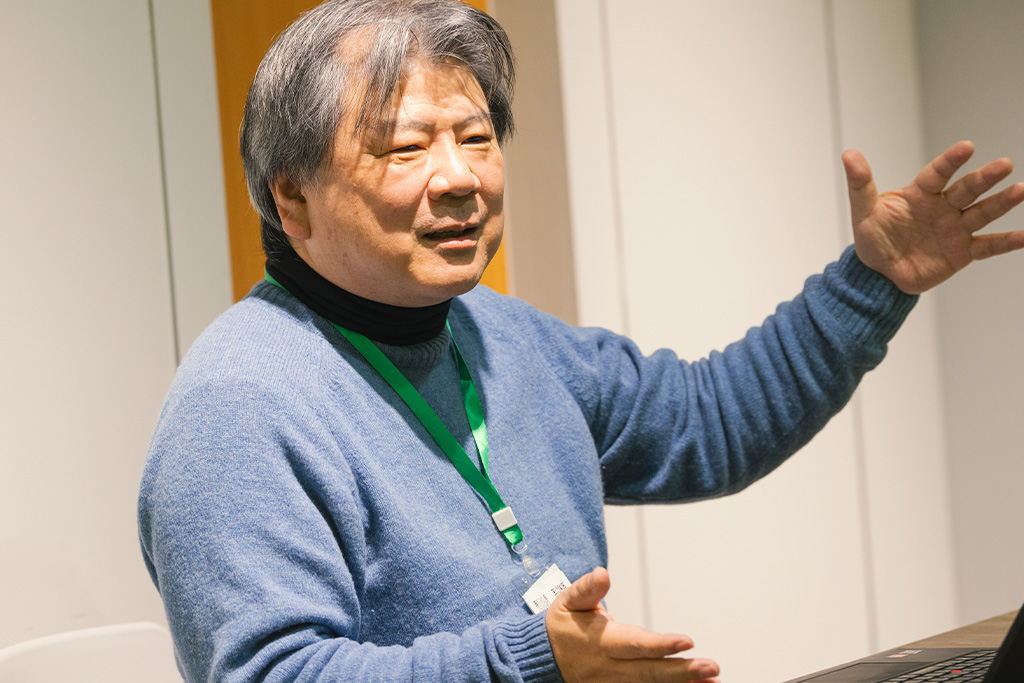
Yokoyama: What prompted me to start CoolAutomation Japan was my experience working for 12 to 13 years at a foreign-affiliated company in the facilities and HVAC industry. During that time, I became acutely aware of the Galapagos syndrome within Japan's industry. Knowing that overseas, initiatives to "openly connect buildings and make them smart" were advancing as a matter of course, I felt strongly that "someone had to do it in Japan too."
Realizing this wasn't something I could tackle alone, I joined overseas building automation companies and firms developing AI-powered urban operation platforms. This led to bringing CoolAutomation headquarters on board as a supplier. Once introduced to Japan, someone had to drive its adoption. That's when I decided, "I have to do it myself," and that brings us to today.
Our goal is to "open up" every building. We are fully committed to building an environment where equipment can freely connect with each other, particularly centered around HVAC systems.
Date: What exactly does "opening up" mean?
Yokoyama: To put it another way, building HVAC automation is a world where "everyone must speak English." But Japanese buildings "can only speak Japanese." Our technology serves precisely as an interpreter. Our goal is to connect Japanese building HVAC systems to open systems that meet global standards.
Date: Are Japan's air conditioning equipment protocols different from global standards?
Yokoyama: That's correct. Japan has adopted its own proprietary protocols, so-called "closed protocols." In the global building automation field, three standard open protocols exist and are the norm. However, these standards are not applied in Japan, and each manufacturer continues to use its own proprietary specifications to this day.
Date: So Mr. Yokoyama is trying to change that situation, isn't he?
Yokoyama: That's right. For AI systems like SOINN to succeed, open connectivity is an absolute prerequisite. Therefore, by leveraging our technology, we aim to create an environment where different systems and equipment can connect seamlessly. Furthermore, by actively expanding our open-source technology, we want to foster greater collaboration across the entire industry. We believe building these "connectivity frameworks" is our role.
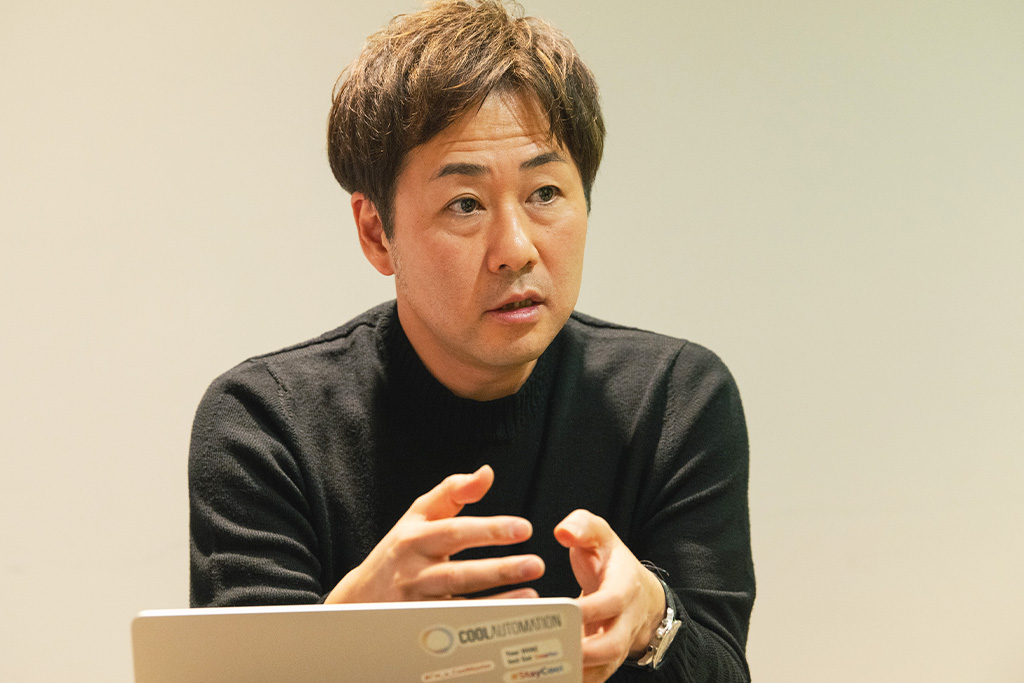
Long-standing challenges faced by both parties were resolved through collaboration.
Date: Your first meeting was at SusHi Tech Tokyo 2024, the global conference hosted by the Tokyo Metropolitan Government, correct? At that time, SOINN was exhibiting, and Mr. Hasegawa also spoke at a Tokyo Consortium session.
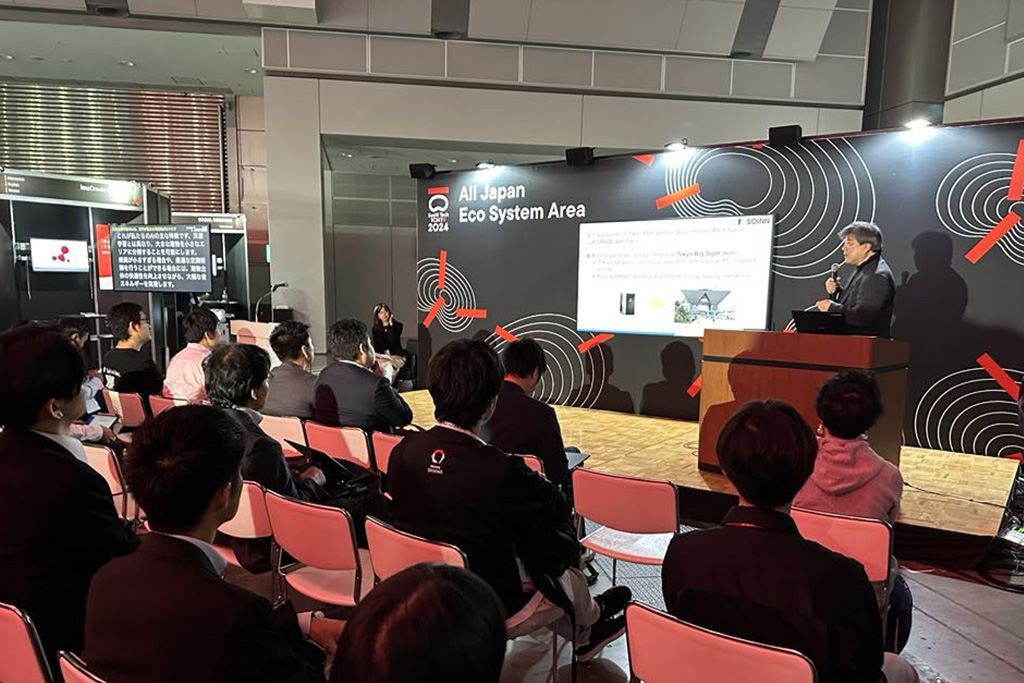
Yokoyama: That's right, our company was exhibiting at the Israel Pavilion.
Hasegawa: We received information that companies whose technologies align with SOINN's were exhibiting, so we visited CoolAutomation's booth.
The moment we heard about it, we were convinced this was the technology that could solve the challenge we'd been facing for years.Our AI functions perfectly once we receive the data, but the problem lies in how to connect it to the HVAC systems. HVAC equipment specifications vary by manufacturer, and some buildings even have mixed systems from multiple manufacturers. This often made it impossible to provide a universal solution for connecting the HVAC, which was a major challenge. However, when I spoke with Mr. Yokoyama, he told me, "It connects to any company's HVAC system," and I was truly amazed.
Yokoyama: Currently in Japan, communication standards differ by air conditioning manufacturer. Company A uses specification A, Company B uses specification B—it's like they're speaking entirely different languages. What's more, there's no unified language within Japan itself.
On the other hand, SOINN's system adheres to a standard language. Therefore, the air conditioning units themselves must be able to speak this standard language to function at all. This necessitates converting all these disparate languages into a common "standard language." Our company creates and provides the underlying mechanism that enables this.
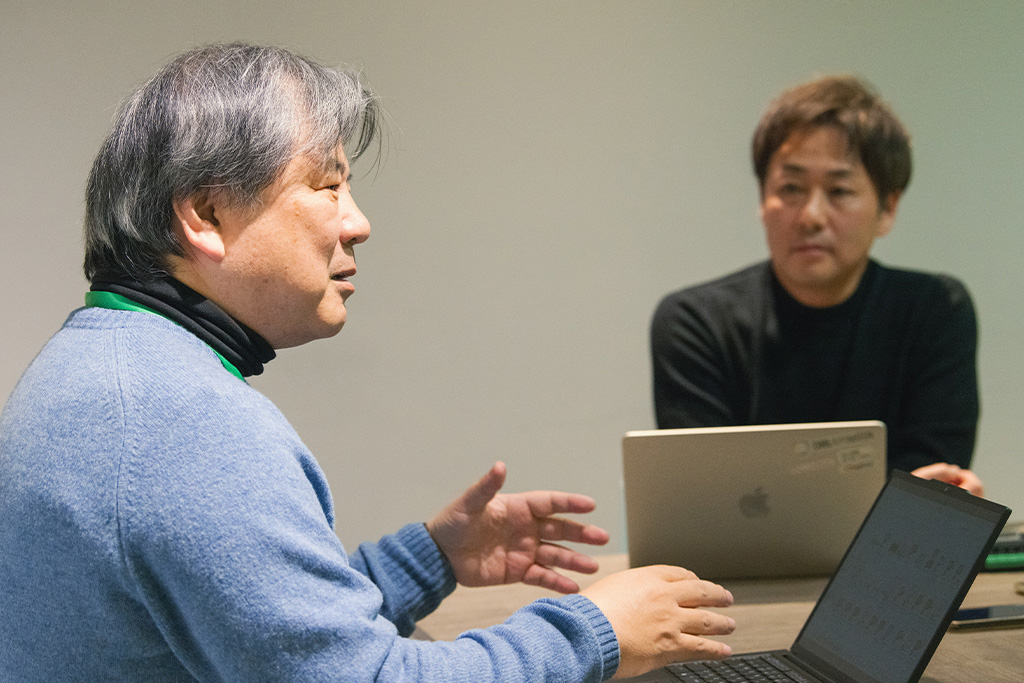
Benefits of Centralized Management for Individual Air Conditioning Units
Date: How exactly are you collaborating?
Hasegawa: When companies consult with us, the conversation almost always turns to "how to connect individual air conditioning units." That's when we propose, "Actually, we're working with CoolAutomation Japan LLC, and we have this solution."
Yokoyama: Ninety percent of buildings in Japan are small to medium-sized, numbering between 150,000 and 200,000 structures. A major challenge is that they primarily only have individual air conditioning systems installed.
The reason systems aren't installed is, as mentioned earlier, because "air conditioning doesn't speak a common language." Our technology has made it possible to solve this, leading to growing understanding from general contractors and HVAC contractors. As a result, inquiries are now coming to Mr. Hasegawa and myself.
The needs of existing buildings fall into two main categories. The first is the demand from companies managing multiple buildings to control air conditioning regardless of manufacturer and achieve energy savings. The second is the desire to eliminate maintenance, which is also a major challenge for companies operating single buildings.
Date: Is building air conditioning quite high-maintenance?
Yokoyama: Japan's air conditioning maintenance system is similar to home appliance repairs. You call, a technician comes → assesses the situation → can't repair it that day → orders parts → makes multiple trips before finally completing the repair. This has become the industry standard process.
By leveraging data here, we can determine beforehand "Is it truly broken?" and "Which parts are deteriorating?" This reduces the number of repair visits, leading to cost savings and labor reduction. In fact, companies that have implemented this system report feedback like, "Maintenance costs have dropped significantly," and "We can now operate efficiently even with labor shortages."
Hasegawa: The primary goals for AI implementation among companies consulting with us are energy savings and labor reduction. For example, at Tokyo Big Sight, veteran management staff adjust the air conditioning daily based on experience and intuition. As the workforce ages, this raises the question: "What happens when these individuals retire?" That's precisely why we need to train AI with their expertise to enable automated operation.
However, rather than full automation, we incorporate a system that alerts humans when issues arise, asking, "There is currently this anomaly. How should we respond?" This approach advances labor reduction while simultaneously achieving significant energy savings as a major goal.
Another implementation goal is "environmental stabilization." For example, in frozen food warehouses, opening and closing doors during operations can easily raise temperatures near the entrance. Meanwhile, the deeper areas maintain appropriate temperatures, so uniformly cooling the entire space wastes energy. In such cases, AI analyzes data and applies optimal cooling only to necessary areas, enabling both energy savings and efficient temperature management.
Date: What types of companies are actually moving forward with hiring?
Yokoyama: While we haven't made an official announcement yet, we are currently advancing projects in collaboration with major developers and general contractors. The types of buildings targeted are diverse, including commercial facilities, hotels, warehouses, data centers, office buildings, and hospitals. We are particularly advancing discussions with hospitals, where temperature and humidity management is critical and where there is clear intent.
Date: It's wonderful that specific projects are already underway.
Yokoyama: Yes. We're also seeing an increase in projects involving the integrated management of multiple buildings. For example, one real estate management company manages about 300 buildings in the Tokyo metropolitan area, 90% of which have individual air conditioning systems. While this was traditionally considered difficult to resolve, driven by a desire to improve the significant energy waste, we are currently collaborating to advance proposals.
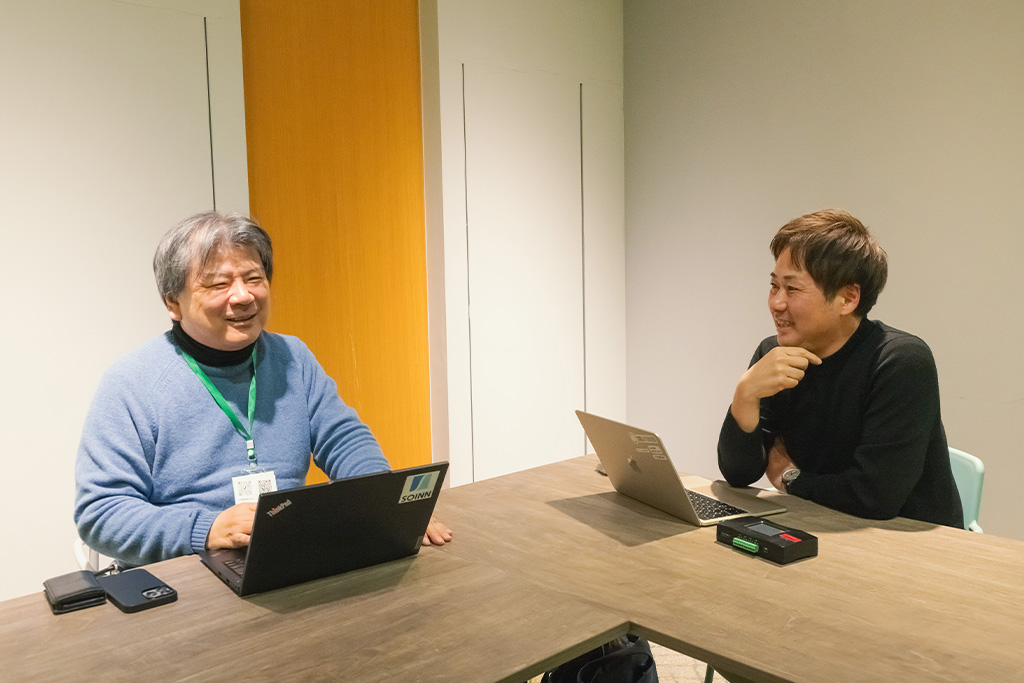
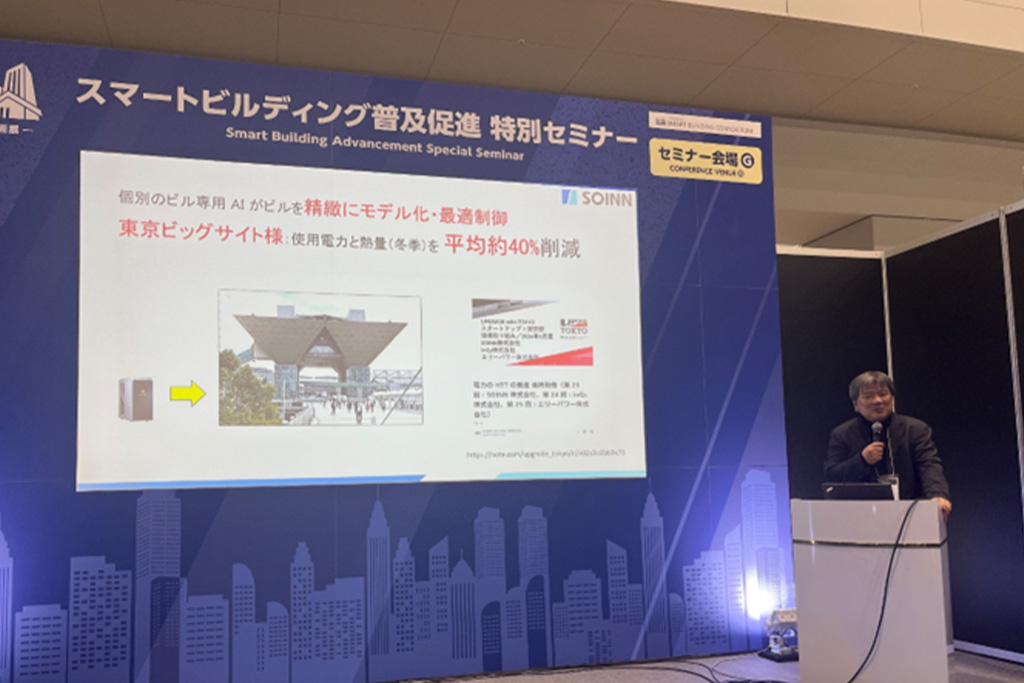
Date: At JAPAN BUILD TOKYO held at Tokyo Big Sight the other day, Mr. Hasegawa was on stage for CoolAutomation's session, wasn't he?
Hasegawa: Yes, we presented the implementation results at Tokyo Big Sight. We are also advancing collaboration in information dissemination in this manner.
Data integration beyond HVAC accelerates openness
Date: As we've been advancing our collaborative efforts, have you noticed anything?
Hasegawa: Solving our initial challenge of "connecting the air conditioning system with AI" has opened up new possibilities. Specifically, we're exploring more advanced optimization by combining air conditioning data with other data. For example, in stores, foot traffic and density can surge suddenly during sales events. Integrating with such crowd flow data enables more precise air conditioning control. A major achievement from this initiative is gaining confidence in our ability to integrate and utilize diverse data.
Yokoyama: Another positive development is that people with aligned goals started naturally gathering together. Simply telling them, "We can connect your air conditioning systems," didn't generate much interest. However, when collaboration progresses in the form of "air conditioning data × AI × other data," interest skyrockets.
On the other hand, the industry's resistance to "opening up" remains quite strong.In Japan, the very concept of "connecting systems openly" is virtually nonexistent. We need to repeatedly communicate to industry players how much more convenient open connectivity can be. Ultimately, we want to create a situation where companies seeking energy savings naturally recognize that "openness is the key to energy efficiency."
Changing the system will enhance Japan's competitiveness.
Date: Please do tell us about future developments as well.
Hasegawa: I want to change closed systems. For example, instead of "You can only use this company's system," I want to create an environment where building owners can freely adopt any technology they want to use. This would sharpen the competitiveness of developers and drive technological innovation.
To prevent Japan from being left behind by overseas technologies, it's crucial for us to increase adoption cases and get people using the technology. If the industry's mindset shifts to "This is what we can achieve," I believe it will ultimately strengthen Japan's international competitiveness.
Yokoyama: My goal is simple: to approach every one of Japan's 200,000 buildings with individual air conditioning systems. Of course, I can't achieve this alone, so I plan to move forward step by step in collaboration with Mr. Hasegawa. To transform Japan's industry, I believe it's crucial for us to build a track record and actively communicate our progress. Ultimately, our goal is to create a situation where, when someone thinks, "I want to advance building automation," our technology naturally comes up as one of the options.
Connections with companies that are difficult to approach on our own
Date: Within the support provided by the Tokyo Consortium, is there any specific aspect you felt was the most beneficial?
Hasegawa: We are still working with the energy storage device company you introduced us to, and you've also helped us establish connections with various other companies. In particular, the opportunity to speak with a major electric power company was an extremely valuable experience. We were able to directly hear the perspectives and challenges faced by energy-related companies, allowing us to visualize more concretely how our technology could be useful. Having access to companies that would be difficult for us to approach on our own was truly appreciated.
In fact, we were also selected for Hokkaido's acceleration program and are now working with a company on energy-saving measures for their data center. Since cooling costs are extremely high for data centers, more are being located in cold regions. This time, we were introduced to local companies beforehand to learn about Hokkaido's energy situation and exchange opinions. This made subsequent project progress, including discussions with government officials, feel very smooth.
Overseas Expansion Support for Global Growth
Date: As part of the Tokyo Metropolitan Government's Advanced Business Dissemination Model Creation Project, the "KING SALMON PROJECT," you visited Helsinki, Finland, didn't you?
Hasegawa: Five companies were selected from Japan, and I participated as one of them. Unfortunately, we didn't make it to the final selection, but the Tokyo Consortium's support, especially in polishing our English presentation, was truly educational. I learned the importance of understanding the country's culture and background while keeping the audience's perspective in mind. I make sure to review the presentation points they gave us every time I create a new presentation.
Additionally, the support we received for competitive analysis was a major benefit when considering overseas expansion. For example, they researched information for us like which companies in Europe could be potential competitors, how far each had expanded their business, and where gaps still existed.
Date: Indeed, clarifying our position overseas is important. Overseas dispatch programs, for instance, are opportunities to connect globally, so participating seems likely to open up various chances.
Hasegawa: That's right. In Helsinki, we've also connected with other companies participating in the Tokyo Consortium, and discussions are progressing about "what we can do together." I believe these lateral connections wouldn't have formed without actually going to the location together.
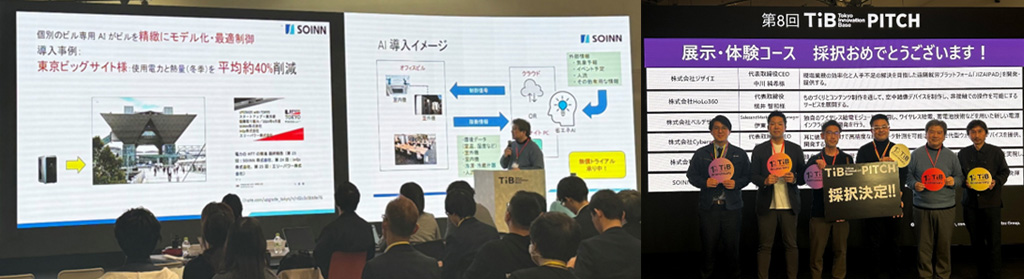
Recently, we were selected at the TIB PITCH event held at Tokyo Innovation Base and had the opportunity to showcase our product. We are truly grateful for the opportunities gained through the Tokyo Consortium.
Date: Finally, could you share a few words for startups considering applying to the Tokyo Consortium?
Hasegawa: Just applying itself provides a great opportunity to re-examine what your company does and what your business plan entails. You have to organize these aspects when creating the proposal, and while I assume most companies already have this prepared, the application process itself is a very valuable experience.While luck plays a part in whether you get selected, the connections made with other selected companies and the inspiration gained from them will definitely lead to new opportunities. If any startups are hesitating about applying, I would definitely recommend giving it a shot.
Date: Thank you for your valuable insights.
Share the article