※The "Deep Ecosystem" is a unique initiative by the Tokyo Consortium that selects startups poised for rapid growth with an eye toward overseas expansion, provides them with intensive support, and propels them toward unicorn-level growth.Selected companies receive support not only domestically but also with an eye toward overseas expansion. This support leverages the Tokyo Consortium's accumulated resources and network, involving diverse members including Tokyo Consortium members, domestic and international operating companies, venture capital firms, and institutional investors.
Substance discovered that generates electricity from waste materials
Kumeda: First, could you tell us about President Ito's career and the background of his entrepreneurship?
Ito: During my student days, I belonged to the Department of Electrical Engineering in the Faculty of Science and Engineering, where I conducted research and development to promote the practical application of high-temperature superconductors. There, I actually handled complex raw materials and experienced firsthand the challenges of commercialization. This sparked my interest in practical application to benefit society, leading me to join a trading company to spread the technology globally.Later, to acquire more essential skills, I joined International Advanced Technology Research Institute, Inc. for further study. While researching ways to create useful products from waste materials, I discovered a unique raw material that generates electricity when exposed to light. This technology led to the spin-off of inQs Corporation.
Kumeda: You discovered a substance that generates electricity, not one that conducts it.
Ito: That's right. It's a photovoltaic material that generates electricity when exposed to light.
Kumeda: After discovering the material, what challenges did you face in bringing it to market?
Ito: When considering how best to leverage the characteristics of materials that generate electricity from light, we concluded that systems capable of generating electricity in familiar locations and using it on-site would be essential going forward. This led to the core concept behind inQs' flagship products, the 'SQPV' and 'SQ-DSSC'—to develop these as 'photovoltaic elements' and make them useful to society.
I still remember it clearly: I filed the patent application for this technology on March 11, 2011, the day the Great East Japan Earthquake struck. While I managed to submit it in the end, I recall the difficulties—the internet connection kept dropping, and there were power outages—because it was an electronic application. That experience made me truly appreciate the importance of a system that can generate electricity on the spot for immediate use, and I was driven by a strong desire to bring this technology into practical use as quickly as possible.
Kumeda: So generating electricity from light means we can achieve local production and consumption of electricity, right?
Ito: You're absolutely right. While I believe large-scale solar projects like mega-solar plans are necessary, I also think it would be beneficial to have systems that generate electricity right where it's needed and use it locally, rather than producing vast amounts of power and transmitting it over long distances via power lines. inQs aims to develop specialized photovoltaic environmental power generation technology focused precisely on that .

Transparent yet capable of generating electricity—"Glass of the Future"
Kumeda: I'd like to ask more about the "photovoltaic element." First, could you please introduce inQs's business activities?
Ito: We develop and provide photovoltaic devices that generate electricity from unused light. Even in low-light conditions, they can generate power as long as light is present. Furthermore, we use environmentally friendly raw materials. Our key strength lies in providing eco-conscious products—a feature absent in existing silicon-based solar cells—by completely avoiding the use of lead, cadmium, and other substances, while sourcing our primary materials domestically in Japan.
Kumeda: The fact that both the light and the materials can be sourced locally within Japan is also important from the perspective of energy security. Could you elaborate on the difference between silicon-based solar cell power generation and inQs's photovoltaic elements, as you mentioned earlier?
Ito: Existing silicon-based solar cells refer to the solar panels most people picture when they hear "solar power generation." They are not the type that are completely black and allow light to pass through the opposite side; instead, they generate power by facing directly toward sunlight. In contrast, inQs's photovoltaic elements can generate high output regardless of the angle of incident light, even when light comes from an angle. Furthermore, because they use a glass substrate, they can generate power from both sides, which is a major difference.Furthermore, a major feature is their high efficiency in generating electricity even under low-light conditions, such as indoor lighting.
inQs offers two main types of photovoltaic elements. One is the 'SQPV', which can generate electricity even when colorless and transparent. The other is the 'SQ-DSSC', which efficiently generates electricity even under extremely low light conditions, such as in dark areas indoors. The 'SQPV' also provides heat shielding, making it an "eco-friendly glass" that simultaneously generates electricity and blocks heat.On the other hand, 'SQ-DSSC' can generate a relatively high output even in dark places. This offers the advantage of continuously supplying electricity without needing battery replacements for devices that previously relied on dry cell batteries.
Kumeda: Since 'SQPV' is transparent glass, it can be used directly for windows in high-rise buildings and homes.
Ito: That's exactly right. We recommend installing them as interior windows, not just using them externally like curtain walls on high-rise buildings, but also placing them inside to make electricity more accessible. Regarding their "transparency," a major feature is that they can be positioned without compromising daylighting—this was a challenging aspect of development. We believe it's crucial that they don't feel out of place even when installed indoors. Their ability to generate power not only from sunlight but also from indoor fluorescent lights is a unique advantage of their transparency.
Kumeda: By installing them on the interior windows of office buildings, we can achieve heat-blocking effects while also generating electricity. Powering the building from this source allows us to create something like an eco-friendly smart building. If we tried to do this with black silicon-based solar cells, the buildings and houses would end up completely black.
Ito: Well, I suppose the visual impression isn't particularly favorable. However, we take pride in its visible light transmittance exceeding 70%, which indicates high transparency, and its power generation efficiency is the world's highest.
Kumeda: I also see potential in the other 'SQ-DSSC'. Even with just a little indoor light, it can power sensors and such. With the trend in the EU to eliminate dry cell batteries, demand for this should increase, don't you think?
Ito: Discussions have begun in Europe to reduce disposable energy sources like dry cell batteries, and environmental power generation technologies are gaining attention. Wherever people live, there is always light. inQs's light-powered generation elements can harness not only sunlight but also such ambient light to generate power on-site. We want to spread this ambient light power generation technology even further.

What we gained from the Deep Ecosystem
Kumeda: inQs has been participating in the Tokyo Consortium's Deep Ecosystem since last September.
Ito: By joining the Deep Ecosystem, we've undertaken various initiatives—leveraging a broad network, receiving advice, and exhibiting at trade shows. Previously, we believed we understood our company's strengths best. However, gaining a broader perspective on our products' appeal proved immensely valuable. Furthermore, we realized that inQs' technology, when used more widely—not just in Japan but globally—can significantly contribute to society.
Kumeda: Thank you. Could you tell us specifically what kind of support you've received?
Ito: We've been refining our business plans and other materials, and regarding the process design needed for our future vision, you've provided proposals incorporating new perspectives that encompass market conditions and social trends. Your concrete advice—such as "How about exhibiting at this kind of trade show?" or "How about seeking out this kind of partner?"—has been invaluable in helping us build the process step by step.
Furthermore, what makes it truly appealing is not just the proposals, but the fact that they actively engage with us in putting ideas into practice. They provided us with an opportunity to exhibit and speak at 'City-Tech.Tokyo', one of Japan's largest startup events. Even then, they offered specific and thoughtful guidance, advising us on points like, "You should highlight these aspects."
Additionally, when installing inQs products at the Tokyo Metropolitan Industrial Technology Research Institute, they assisted with preliminary surveys and accompanied us on site visits, truly working alongside us and putting in the hard work.
Installation of 'SQPV' at the Tokyo Metropolitan Industrial Technology Research Institute
Kumeda: Please also tell us about the installation of the Tokyo Metropolitan Industrial Technology Research Institute's product, Mr. Ito. It all started when you took the stage at last year's 'UPGRADE with TOKYO' and won, right?
Ito: We won the "Generate (T)" category within the Tokyo Metropolitan Government's HTT Project (which stands for "Reduce (H)," "Generate (T)," and "Store (T)" energy). Generating energy within cities is challenging, but there remains a vast amount of untapped energy. Our approach at inQs, which focuses on harnessing unused light to create energy, was recognized.
Kumeda: Could you tell us what the purpose is behind the 'SQPV' that was established in March 2023?
Ito: First, we installed this to introduce you to 'SQPV', our transparent photovoltaic glass. It can also function as a partition. We set it up in a way that feels natural, demonstrating how 'SQPV' photovoltaic glass—which looks like ordinary glass at first glance—can generate electricity even under indoor lighting.
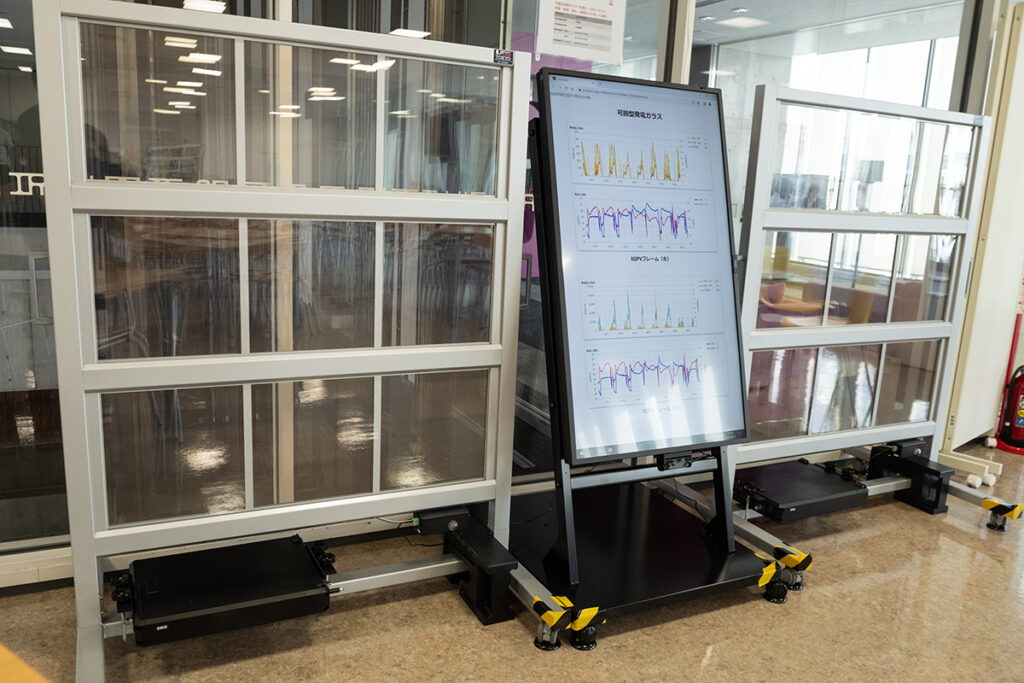
Kumeda: In July, you installed the SQPV interior window system. Could you tell me the purpose of that?
Ito: We installed this 'SQPV' transparent photovoltaic glass on the inside of all 16 windows on the 5th floor of the Tokyo Metropolitan Industrial Technology Research Institute. We are collecting real-world data—data that cannot be obtained through testing—on how much electricity can be generated using both sides of the photovoltaic glass to capture light energy obtained within an actual living environment. We also believe this has been a good opportunity to widely demonstrate that it can be installed on existing buildings even after construction and that it can be removed.
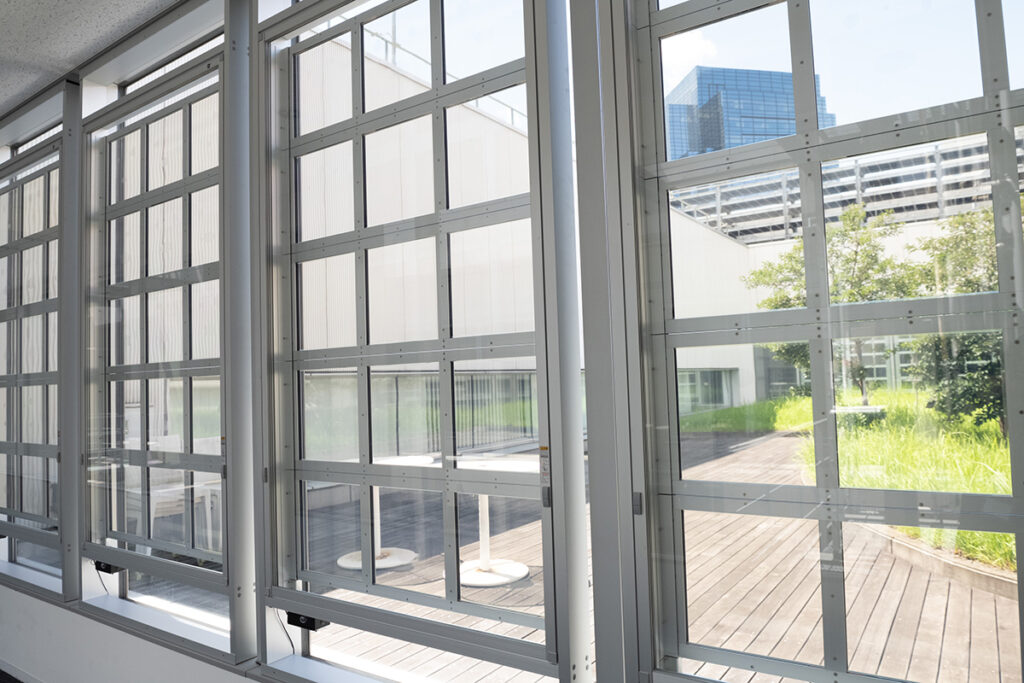
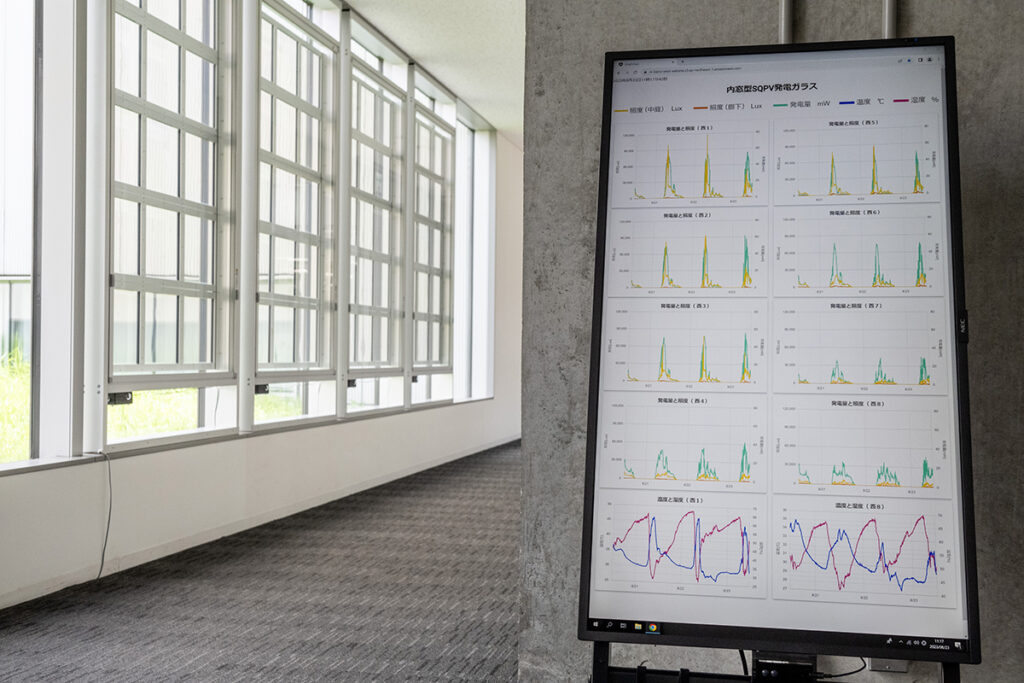

Kumeda: Currently, we recommend using SQPV transparent photovoltaic glass for interior windows. But in the future, will it be possible to use SQPV for exterior windows in new office buildings and homes?
Ito: It's entirely feasible to offer it as part of the building structure, such as on walls or windows. While we're starting with interior windows as a first step, we're already developing technology for installation in new construction windows. Simulation data shows that replacing standard window glass with 'SQPV' can reduce air conditioning costs by approximately 40%.
Growing global demand for environmental power generation technology
Kumeda: Where do you think the latent demand for SQPV lies among private companies?
Ito: inQs is focused on locally generated and consumed energy through what we call environmental power generation technology. Since glass is used worldwide, we believe the demand for our 'SQPV' transparent photovoltaic glass—which generates electricity on-site using ambient light—is immeasurable.In Europe and the US, regulations have already expanded the market for renovations and refurbishments using environmentally conscious, high-value-added glass. While heat-shielding and insulating window glass exists, transparent glass that also generates electricity is still absent from society. This unique capability will drive demand for products offering differentiated added value.
Furthermore, by storing the electricity generated, its subsequent applications become infinitely expandable for customers. I believe this potential for application also holds tremendous future market appeal.
Kumeda: In that context, what challenges do you currently perceive?
Ito: I believe that by steadily demonstrating and explaining the product, customers will come to appreciate its value. The challenge lies in how we can accelerate that process.
Kumeda: What do you think is necessary to spread 'SQPV'?
Ito: It's about sharing the value of use. To that end, we are accumulating data on power generation output and on the energy-saving effects achieved through heat shielding.The light energy that forms the basis for power generation in actual living environments is diverse—including light entering at angles, reflections off building windows, and illumination from streetlights. We've discovered that even dim light can yield high power output. By combining the electricity generated from this with other solutions, such as powering sensors, we aim to create products that quietly support the creation of better living environments.
Kumeda: It seems we could also control the air conditioning for the entire building using the electricity we generate.
Ito: For example, I believe we can use the electricity we generate to monitor the environment inside a room—where the back side is too cold due to excessive air conditioning, while people near the front feel too hot—and control the air conditioning more precisely.
Kumeda: Since there are limits to how much wiring we can install, we can likely power various sensors by installing 'DSSC' panels on the ceiling for low-light operation and replacing windows with 'SQPV' units.
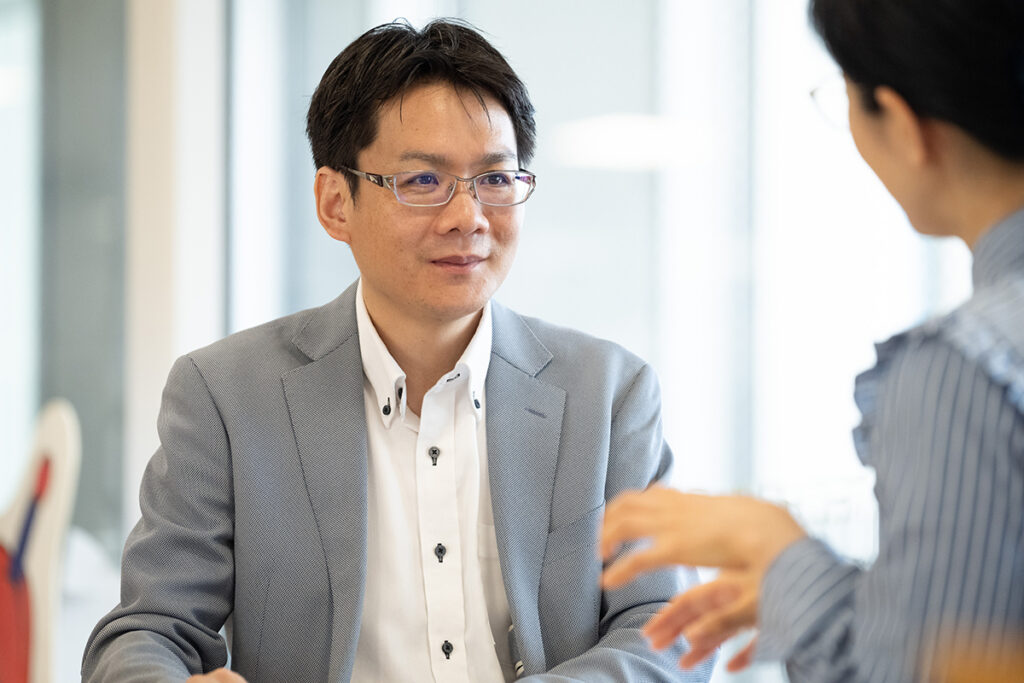
From Tokyo to the world. The future envisioned by inQs.
Kumeda: What are your thoughts on overseas expansion?
Ito: We are actively working to deliver "Tokyo-born" technology to the world. We are currently in the planning stage for business partners and sales expansion.
Kumeda: We definitely want to establish a mass production system so we can export Japanese technology.
Ito: I believe this technology holds the potential for Japan to become an energy exporter, so I'm determined to push forward. Ultimately, my vision for the future is to develop portable energy sources that can be carried around as easily as a mobile phone.
Kumeda: I also feel that SQPV's transparent photovoltaic glass holds tremendous potential. You can't just slap black silicon solar cells on windows of buildings or homes, whether indoors or out. In fact, we've identified ways to significantly reduce costs in the future, and mass production could lead to rapid adoption.Currently, we're using it on interior windows to gather data, but I envision a future where 'SQPV' transparent photovoltaic glass is used on every window of newly built homes and even 30-story buildings. I want to support a future where Japanese technology is exported globally, not just confined domestically. Finally, could you share a message for startup founders considering applying to the Tokyo Consortium's Deep Ecosystem?
Ito: Creating new innovations and building new business models is no easy feat, but to seize that opportunity, action is the only way forward. Receiving support from a deep ecosystem also expands your horizons. I truly hope you will rise up as a startup company.
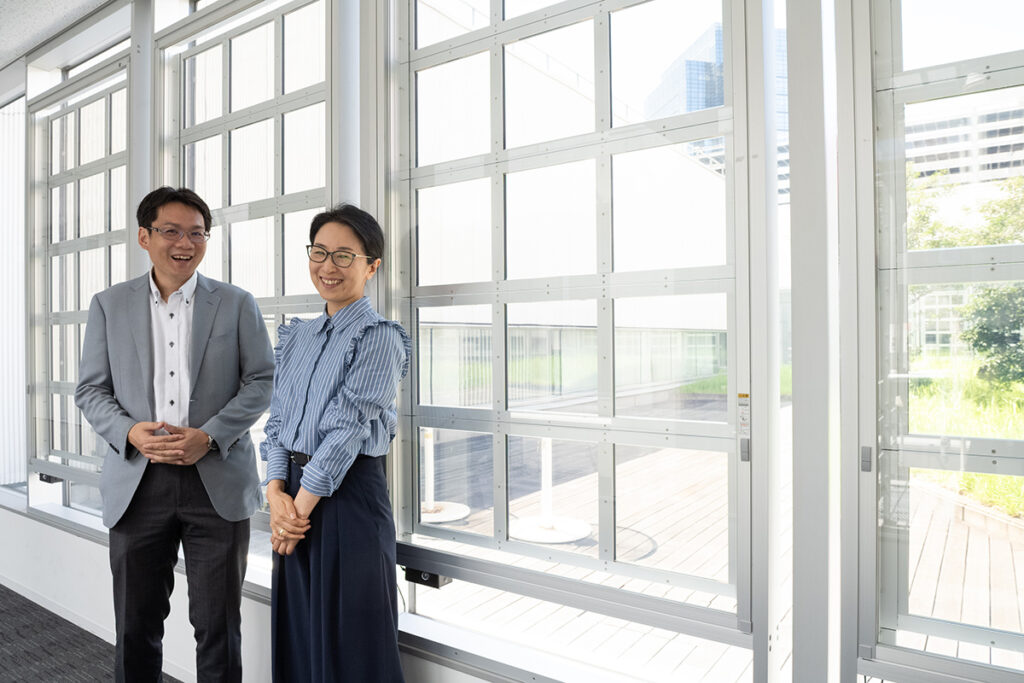
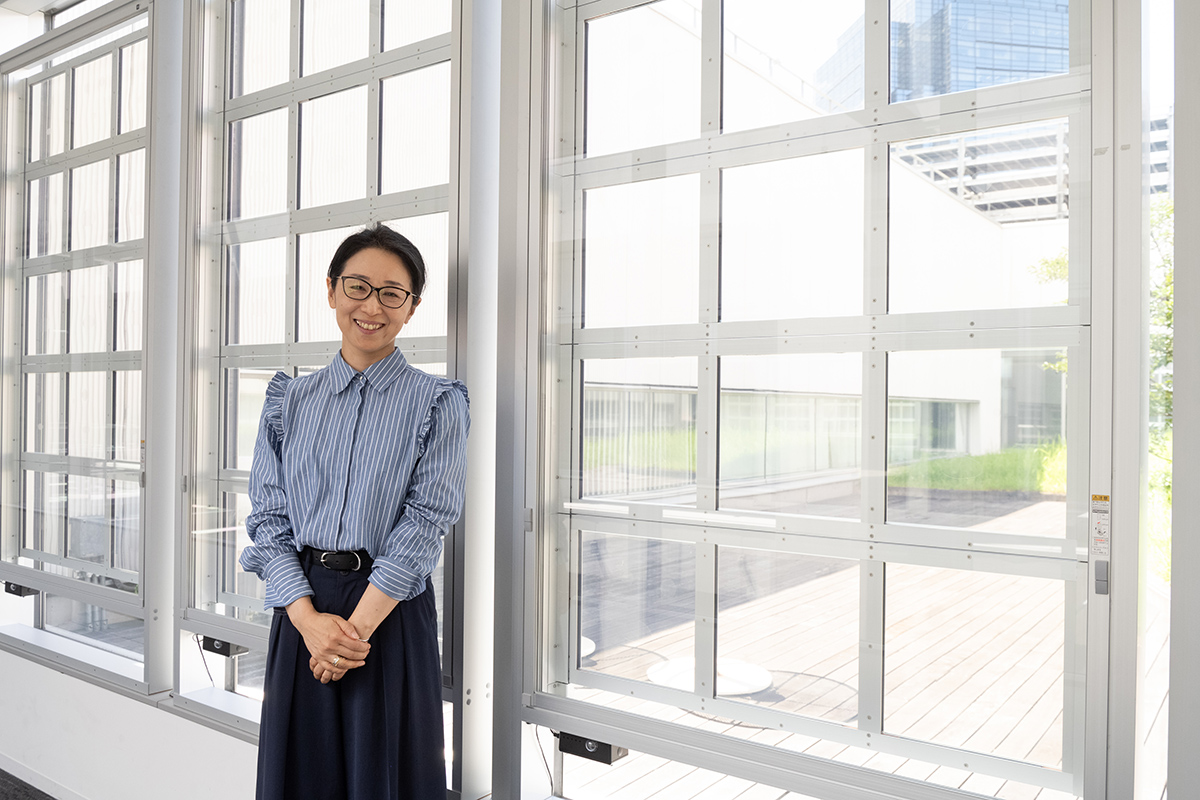
Tomoko Ito
inQs Inc.
After graduating from university, she joined Sumitomo Corporation. She subsequently served as Managing Director and CTO at International Advanced Technology Research Institute, Inc., which conducts development projects connecting technology from seed to need. She then spun off the company using photovoltaic element technology and established inQs Inc., where she remains to this day.
Share the article